Swave’s Holography Vision Raises Additional Funding


eeNews reports that holographic projection startup Swave Photonics NV (Leuven, Belgium) has raised an additional €3 million in seed funding, taking the amount raised by the company to €10 million.
Swave, founded in 2022, is a spin-off from the Interuniversity Microelectronics Centre (IMEC) research institute that is working to commercialise holographic chips based on diffractive photonics technology. The company’s business model is to be a component and subsystem provider.
The company has attracted US-based investors Acequia Capital (Seattle, Washington) and Luminate NY (Rochester, NY), an optics, photonics, and imaging accelerator. These investors have joined established Belgian investors imec.xpand, a venture capital fund centred around nanotechnology innovation, Flanders Future Techfund (FFTF) and QBIC, a Belgian inter-university venture capital fund.
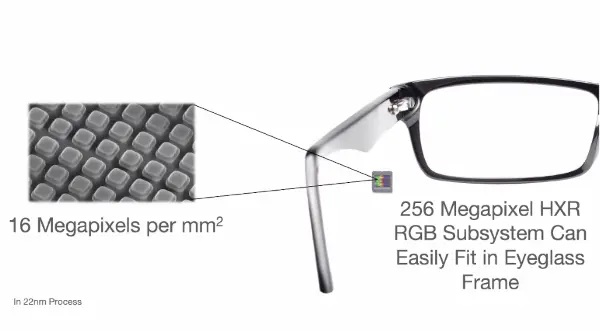
High density pixels (© Swave).
Technology
The company’s technology is based on sub-wavelength pixels with the optical properties of phase-change material laid down over silicon. Swave uses a conventional alloy of germanium, antimony and tellurium (GST), the same type of material used in the fabrication of CDs and DVDs. GST can exist in two states – disordered or crystalline – with different reflectivities.
By making arrays with a pixel-pitch below the wavelength of visible light it is possible to programme the visual field to produce an optical wavefront, as if from a real object.
‘Holography is an end goal for augmented, virtual and extended reality, to provide 3D visualisation that works with human vision,’ said Mike Noonen, CEO of Swave. ‘IMEC looked at a lot of technologies, DLP, MEMS, microLED, but at best they were around a 2-micron pixel pitch. Not only does GST get to 225nm pixel-pitch but, by manufacturing on 22nm planar CMOS (complementary metal-oxide semiconductor), the technology can use the economics of silicon to ease entry to market at high yield,’ he added.
Theo Marescaux, Chief Product Officer and founder at Swave, said the technology does not require waveguides, eye-tracking or varifocal lenses, making for simpler systems for smart-glasses or goggles. Noonen said that other 3D technologies induce nausea and headaches by sending conflicting signals to the brain. Only holography provides natural focus and convergence.
Another benefit of the fine-pitch system is that it can support a wide field of view of more than 100 degrees at high resolution.
Prototype
The company has produced a first prototype ‘HXR’ chip. This is the first dynamic holographic chip which Noonen said Swave expects to exhibit behind closed doors at the CES event in Las Vegas in January 2024. This is a 256Mpixel RGB chip. A 4mm by 4mm die with 16k x 16k pixels. That equates to a pixel density of 16 Mpixels per square mm. With 3x magnification this will provide a useful 12mm by 12mm ‘eye-box’. Applications will probably make use of a tri-diode laser for illumination although the technology does not need spatially coherent light, said Marescaux.
Noonen declined to say which foundries Swave is working with but said these include both R&D lines and volume manufacturing foundries.
As yet unproven
There are still aspects of the technology that have to be proved. For example, can the technology switch quickly enough to support video? Marescaux said: ‘The pixel switching is very fast at less than 300ns. That gives a few MHz pixel rate.’
Noonen also made the point that the sub-wavelength visual application is forgiving of individual failed pixels.
According to the company the seed funding would be used to accelerate engagement with customers and partners for glasses and goggles with a view to product introduction in 2024. There are also potential free-space applications such as displays or a second-screen for a smartphone, where the non-volatile nature of GST could save power for some essentially less dynamic information.
Swave has 16 employees at present and funds would be used to bring more hardware and software engineers on board, said Noonen. ‘But we also expect to leverage the resources of partners who will be telling us what they want.’
www.eenewseurope.com/en/swaves-phase-change-holography-raises-more-money
Subscriber content
Read the full article
Full access to Holography & Optical Technology News articles, newsletters and archives.