Holograms on ID Documents – Where Next?

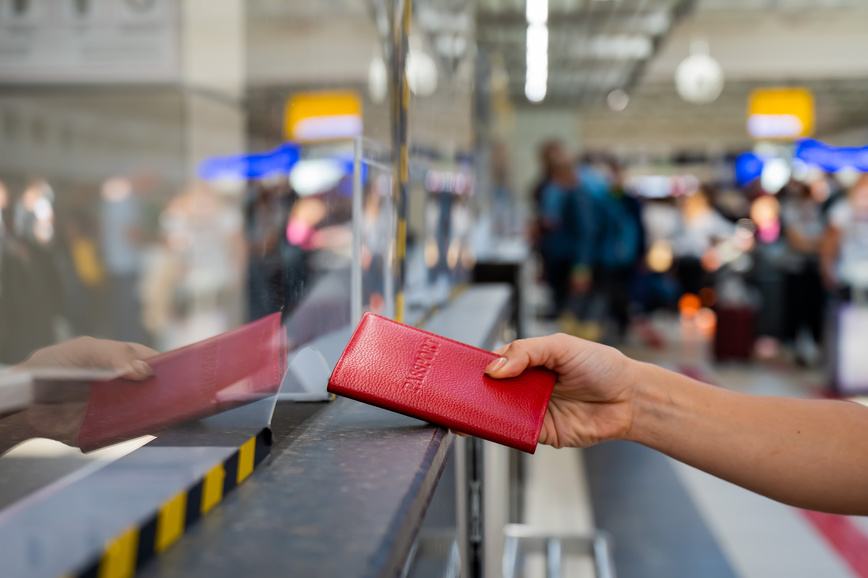
Holography, and other optical security devices, have become a mainstay of document design when it comes to protecting the photo and personally identifiable information on ID cards, passports, visa stickers and other documents for authenticating a person. They serve as a combination of security and anti-counterfeiting measures, as well as a visually appealing and durable element to enhance document authenticity and protection.
In this article, we review the history and evolution of the technology up to the present day and ask what’s next for holograms on ID cards?
Early adoption
The first commercial use of holographic imagery on an identity document is most likely to have been the California driving licence in the early 1990s – a few years after the first hologram appeared on a banknote in circulation (the Austrian 500 schilling). At that time, holograms played, and to a large extent still play, a very different role on ID documents compared to banknotes.
In the former, the biggest vulnerability for an ID document was simple replacement of the photograph of the bearer, whereas the threat to the integrity of banknotes was coming from the new computer graphics packages and ink jet printers that were making significant improvements while at the same time coming down substantially in price .
The California licence used a partially transparent demetallised holographic material that overlayed the photo, so encapsulating it from direct substitution without obvious signs of tampering. So, while we say that the California driving licence is most likely to have been the first ID document to have been protected with a hologram, it doesn’t remove the possibility that a hologram was used as a fully reflective device earlier in the 1990s.
Once the principle of ‘see-through’ holograms was established as an anti- manipulation device, it wasn’t long before high-refractive index (HRI) coatings were developed to improve visibility of both the holographic image and the text and graphics underneath it. This opened the way for partially transparent holograms to be used as overlays on biographic data in a passport.
From that point on, the hologram was used not only as an authentication feature but also to protect the biodata contained within the passport.
Standards
In December 2004, the European Union incorporated EC Resolution #2252/2004 1 for minimum standards for security features (and biometrics) in passports and travel documents. Paragraph 4 of the Annex states that ‘the optically variable device (OVD) should be integrated into the document as an element of a layered structure, effectively protecting against forgery and falsification. In documents made of paper, they should be integrated over as wide a surface as possible as an element of the hot-sealed or an equivalent laminate (as thin as possible) or applied as a security overlay’.2
Another key standard that enshrined the use of holograms on travel documents, and ID documents more widely, was the International Civil Aviation Organisation’s (ICAO) response in 2002 to security shortcomings highlighted by the terrorist attacks of 9/11.
ICAO Doc 9303 ‘Machine Readable Travel Documents’ 3 states that: ‘when the biographical data page of a passport book is protected by a laminate or overlay, an optically variable feature (preferably based on diffractive structure) should be integrated into the page. Such a feature should not affect the legibility of the data. The inclusion of a diffractive optically variable feature is recommended to achieve an enhanced level of protection against reproduction.’
The modern era
By the mid-2000s, a combination of technology advances and regulatory requirements meant that holograms had become an almost indispensable first level deterrent on passports and other means of authenticating an individual. The materials used had proved themselves capable of withstanding the rigorous demands of the document’s 10 year lifetime and that they could be cost-effectively integrated into a variety of production processes.
Holograms, having established themselves with multiple worldwide references, now started to evolve in different directions.
One example was the German identity card to which the Federal State Security Printer, Bundesdruckerei (BDR), added the Identigram® Overlay and a holographic copy of the holder’s picture (the so-called Holographic Shadow Picture – HSP®).
For the newest version of the German ID card (see IDN September 2021) the Identigram has been updated with new design elements as well as the inclusion of a third colour (blue) for particular elements, adding to the existing colours of red and green – which depict for example the 3D German eagle in red and the HSP in green.
Hologram.Industries (now SURYS, a part of IN Group) took a different approach with their DID® visual security device.
Visually distinct from traditional holograms, this is a zero-order optical nanostructure combined with thin films. It is basically a two-colour diffractive image appearing at the direct reflection angle which changes when the document is rotated through 90°. The technology has so far been adopted by many countries around the world, including China.
Hybrid technologies
Today’s direction of travel for holograms on ID documents is for hybrid technologies that are perfectly integrated with other security features and printing. Some technology providers have moved away from the typical fringe spacing of a hologram (roughly between 300-700 nm) and increased the feature size to create Fresnel effects while others have gone to smaller dimensions to harness evanescent wave technology for structured colour.
But whatever the technique deployed to create shifting colour and movement effects, one thing is clear, optically variable devices have to integrate with and play off the other security features on the card or document.
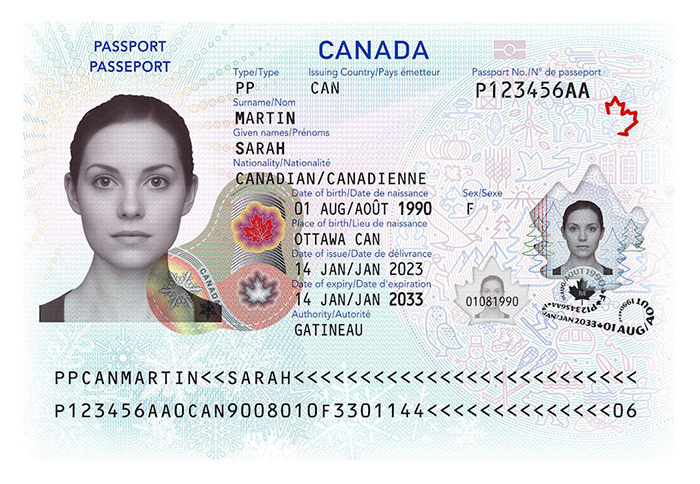
One example, the new Canadian passport, includes a polycarbonate datapage and features a Kinegram® over the main photo, a custom see-through window with a secondary image of the passport holder, a variable laser image, and a temperature sensitive ink feature.
And the new Bahamas driving licence (which received recognition at this year’s Regional ID Document of the Year Awards) is protected by a large array of complex features integrated into the card including rainbow graphics with guilloche pattern, microtext with deliberate error, relief effect microtext, OVI, CLI, UV print, personalisation with laser engraving and a Kinegram®.
1 - https://eur-lex.europa.eu/legal-content/EN/ALL/?uri=CELEX:32004R2252
2 - https://platform.keesingtechnologies.com/innovation-drives-hologram-document-protection/
Subscriber content
Read the full article
Full access to Holography & Optical Technology News articles, newsletters and archives.