Progress for Light Field Labs


In December 2021, Holography News® reported that Silicon Valley startup company, Light Field Lab, was accepting advanced orders for its holographic display platform, dubbed SolidLight. Now that SolidLight is in production. we can follow up on the progress the company has made.
SolidLight is a high resolution, high image density projection system that can create wavefronts to form real images in space. The complete system includes modular video wall panels, servers, networks and the WaveTracer™ real-time rendering software.
The technology creates a real image of a scene. A real image is a collection of foci of converging light rays. You can confirm that an image is real, as opposed to virtual, by placing a screen or ground glass into the body of the image and physically ‘capture’ it.
To achieve the production of a real image, the company’s branded display device, SolidLight, generates a massive number of viewing angles that correctly change with the point of view and location, as your eyes and visual processing system would do in the real world.
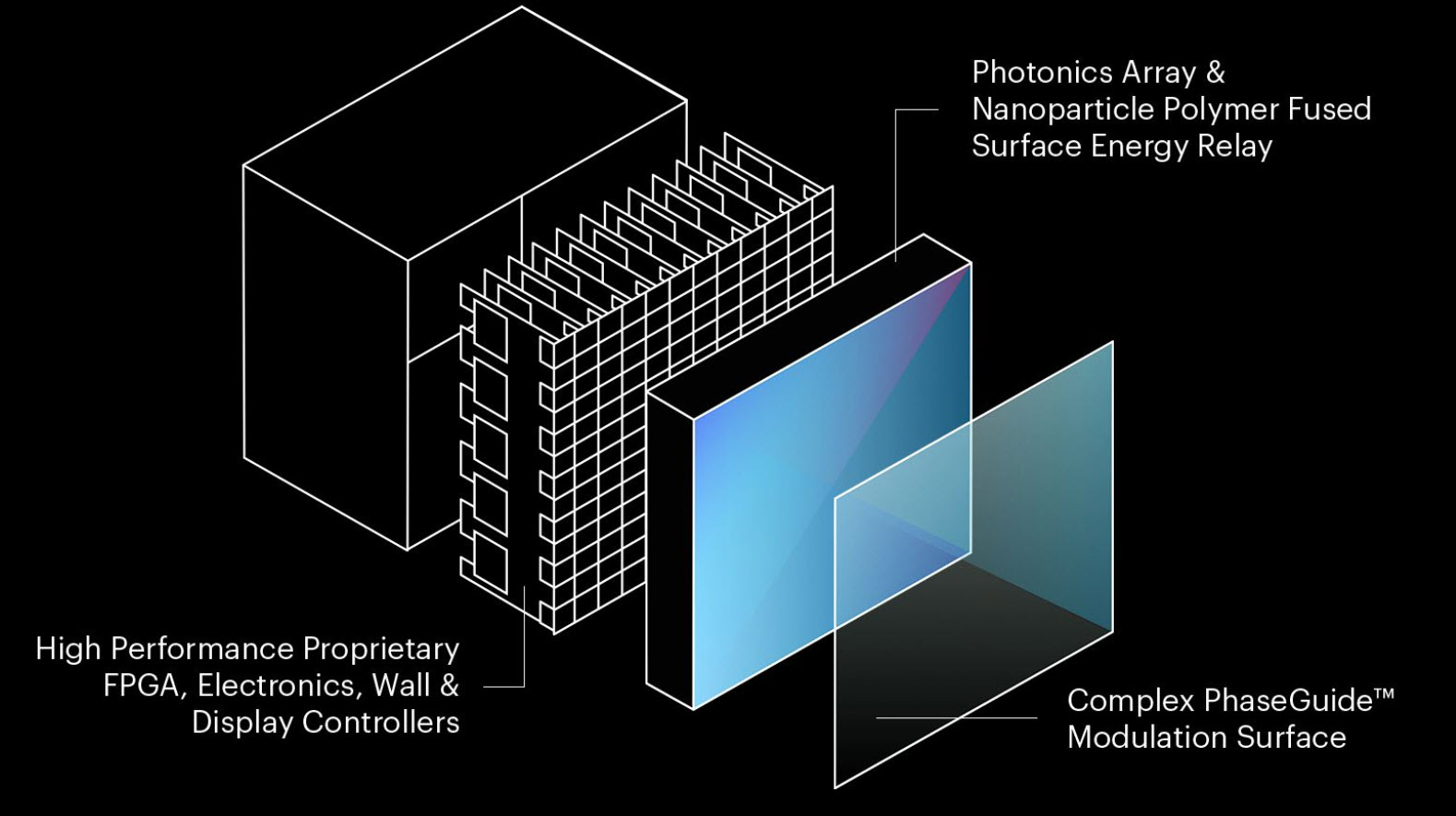
This is accomplished with a directly emissive, modular, and flat-panel display surface coupled with a complex series of waveguides that modulate the field of collimated light rays. With this implementation, a viewer sees around objects when moving in any direction such that motion parallax is maintained, reflections and refractions behave correctly, and the eyes freely focus on the items formed in mid-air.
SolidLight (© Light Field Labs).
Media coverage of SolidLight has remained unanimously positive, with Forbes writing that ‘SolidLight displays are a completely new method of creating 3D objects that appear to be real and placing them in the physical world. They look real to the eye, but are formed with nothing but light. No glasses are required to see them 1’.
The displays have also received critical acclaim in the TIME Best Inventions of 2022 category, with the citation reading: ‘SolidLight holograms protrude into mid-air and behave, visually speaking, like the physical objects they’re meant to embody 2.’
The development of light field displays goes back to the early 1900s and the work of Gabriel Lippman’s ‘integral photography’. In contrast to regular photography, which focuses light from a scene onto a light sensitive medium, light field displays imagine the waves emanating from a scene to be a field of light that can be described by the intensity of light at each position within the field and the direction that each light ray is travelling.
Unlike a hologram, that records the amplitude and phase relation of the wave fronts reflected (or in some cases emitted) from an object, light fields are best thought of as a vector function of the amount of light flowing in every direction through every point in space.
Since our previous article on the company, Light Field Labs have released a new set of encounters with light called Defy™, which allows viewers to interact with a SolidLight hologram being computationally rendered in real-time by a game engine. The hologram is formed using the SolidLight panel modulating over 2.5 billion pixels, using their new WaveTracing™ engine that performs billions of wavefront computations in real-time to form the interactive holographic objects.
The system’s modular video panel design means that the final display size can be anything from a single 28” panel of art up to a 224” 3D display in entertainment venues or public spaces.
The company was founded in 2017 by three veterans of Lytro, which developed some of the first commercially available light field cameras. Since then, Jon Karafin, Brendan Bevensee, and Ed Ibe have raised a total of $85 million, backed by Bill Gates (Gates Frontier), Vinod Khosla (Khosla Ventures), and a prestigious list of venture capital firms, national technology funds, and strategic corporate partners.
The lead investor in the Series B round of funding is a leader in interactive experiences, called NCSOFT.
‘Light Field Lab is building the future of immersive experiences and we are pleased to support the team in bringing true holograms to life,’ said Dr Songyee Yoon, Chief Strategy Officer for NCSOFT. ‘Being able to see, deliver and interact with 3D content without any assistive peripheral devices will substantially advance the consumer adoption of SolidLight, not just in the entertainment space, but also the way in which we interact and collaborate through remote technologies.’
2 - https://time.com/collection/best-inventions-2022/6228926/light-field-lab-solidlight/
Subscriber content
Read the full article
Full access to Holography & Optical Technology News articles, newsletters and archives.