NASPS – Build It and They Will Come


The African Currency Forum (ACF), held in Luxor, Egypt in January, gave the host country a chance to showcase its new Printing House and Cash Centre, and the National Company for Advanced Industries and Integrated Strategic Printing Solutions (NASPS). NASPS has already set up full service holographic production facilities, which has to be said went largely unseen and unreported by Holography News® – so we decided to investigate a bit further and find out more.
The idea behind the creation of NASPS was to unite under one roof the production of a wide range of ID and travel documents, excise stamps, holograms, security paper, payment cards, personalisation systems and the development of information systems and storage. Described as one of the most advanced sovereign security printing facilities in the world, the ultra-modern complex is intended to make the country fully independent in terms of the production of state and ID documents and forms a central part of the government’s strategy for digital transformation and automation.
The speed with which NASPS has assembled the holographic equipment and knowhow is impressive. In less than three years, the organisation set up a hologram production facility involving design, e-beam origination, embossing (up to 690mm wide), demetallisation and finishing. It is already producing the foil stripes and patches for a number of documents, including Egyptian excise tax stamps. Holographic threads for banknotes are on the horizon, as is metallisation and, potentially, its own foil production.
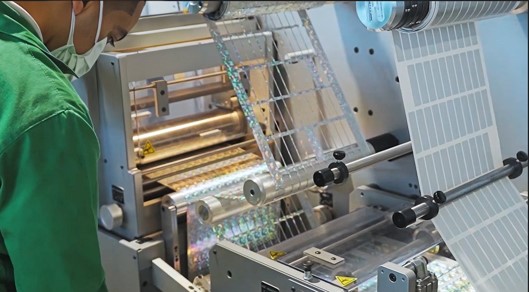
Holographic converting equipment (© NASPS).
NASPS was officially opened in April 2021 by Egypt’s President, and the site spans just over 100 acres in the New Administrative Capital, encompassing an administrative centre and offices, production buildings, services, and a data centre. It was constructed at a reported cost of approximately $1 billion.
Vertical integration
Vertical integration forms part of the organisation’s strategy, with self-sufficiency not just for the documents themselves but their components.
‘Before NASPS, we used to import holograms from outside, like many countries that don’t have their own holographic factories,’ said Ahmed Ehab, representative from NASPS. ‘We have already completed the first two phases of our strategy (growing capacity and satisfying domestic market requirements) and now we are ready to embark on the third phase – international projects.’
NASPS runs three shifts 24/7, employing more than 700 staff, while within the holography division there are around 60 employees spread across the various roles of origination, mass production and converting. The organisation is aware that the role of the hologram is evolving quickly from a standalone visual counterfeit deterrent to an element within a wider security programme.
‘Not only do we design, originate and manufacture our holograms but we have the capability to over-print, code and convert them’, said Ahmed. ‘We also have the ability to link the code to our own track and trace software’.
Special Recognition of Achievement Award
The speed with which NASPS has got up and running is partly driven by the determination of the Egyptian government to modernise the country’s ID system and make production of government issued documents a sovereign enterprise.
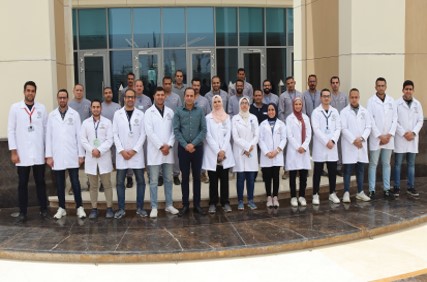
Selection of the hologram team (© NASPS).
Up until 2008, Egyptian passports were personalised with handwriting and had poor levels of physical and information security but within 15 years Egypt has moved from handwritten passports to biometric ones.
Commissioning the NASPS industrial complex was part of that transition – covering the value chain from the production of secure paper to personalisation of biometric ID documents.
In recognition of this remarkable feat, NASPS was awarded the Special Recognition of Achievement Award at the prestigious Regional Banknote and ID Document of the Year Awards ceremony at the recent High Security Printing™ (HSP) EMEA conference, Abu Dhabi.
Subscriber content
Read the full article
Full access to Holography & Optical Technology News articles, newsletters and archives.