3D Zero Order Imaging – the People’s Choice


As is the tradition, the winners of the Excellence in Holography 2022 Awards were judged by Board members of the International Hologram Manufacturers Association (IHMA) and presented as part of The Holography Conference Online.
But, also following tradition, it is the IHMA membership and conference attendees who get to vote online for their favourite technical advance in holography during the year. The ‘People’s Choice’ for 2022 was won by the Computer Holography Centre for a new holographic principle, called 3D Zero Order Imaging.
The new technology was presented during the conference by Anton Goncharsky, CHC General Director, providing a fascinating insight to the generation of new features that act like real 3D objects.
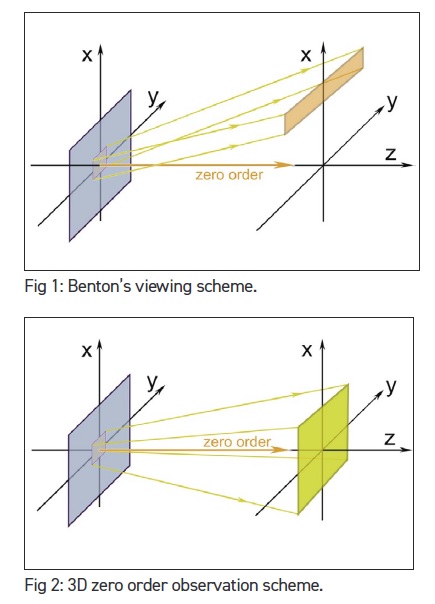
Rainbow, or Benton, holograms are a well-established method for forming 3D images that provide horizontal parallax but suffer chromatic aberration when inclined vertically and offer a very narrow range of viewing angles. The geometry of Benton’s approach also results in the image disappearing completely when the viewing angle exceeds a certain value.
To remedy these limitations, Anton Goncharsky set himself the task to synthesise an optical element which forms 3D images that behave more like a real 3D object in that they have full parallax, stable colour and have a wide viewing angle including rotation through 360 degrees.
In Benton’s observation scheme, the 3D image is formed in the first order of diffraction and the observation area is a limited narrow band.
When the optical element is slightly tilted or rotated, the observer’s eyes leave the area of observation, and the 3D image is no longer visible.
In contrast, as long as the observer’s eyes are within the region shown in Fig 2, an observer sees a 3D image and the image is seen over a wide range of tilt angles and even when the optical element is rotated through 360 degrees.
The realisation of the concept is in two steps:
1. Calculation of a phase function/ microrelief of a flat optical element. To give some idea of the processing challenge this presents, for a 100x100 nm grid, the number of points is in the order of 1012.
2. After the calculations have been processed, a high accuracy microrelief pattern is recorded on a flat optical element.
The practical implementation of the 3D Zero Order element is by microrelief structures formed by e-beam lithography. The resulting 16x16 mm2 flat optical element is comprised of 160,000 distinct regions, each with dimensions 50x50 μm2 and 55 horizontal and 15 vertical frames. The wavelength for calculations is 547 nm.
The 3D images created through this technique can be observed when illuminated by white light. The observer seeing the 3D image with full parallax, both when the optical element is tilted and when it is rotated through 360 degrees.
In addition, unlike rainbow holograms, the colour of the formed 3D image does not depend on the viewing angle – in other words, the 3D image behaves more like a real 3D object.

Subscriber content
Read the full article
Full access to Holography & Optical Technology News articles, newsletters and archives.