
Disney’s Still Curious About Holograms

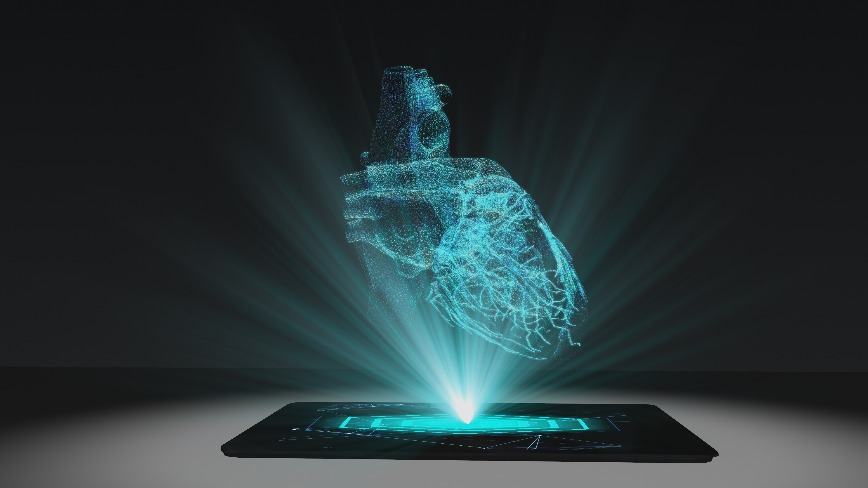
It shouldn’t come as any surprise to anyone who has seen Disney movies such as ‘Ralph Breaks the Internet 1’ or visited any of their theme parks that the corporation takes holograms – both physical and digital – very seriously. The love affair between Disney and holograms goes back more than 40 years and shows no sign of breaking up.
In his interview with Holography News® (HN April 2022), Chris Rich, CEO of WaveFront Technology Inc, attributed his fascination with holography to a holiday visit to a Disney theme park. ‘I was on vacation at Walt Disney World’s EPCOT centre in 1983 and saw a large-scale stereogram by Craig Newswanger (Advanced Dimensional Displays) and I knew right there I wanted to have a company involved in making holograms’.
Craig, who had worked in the ‘Illusioneering’ (to complement Imagineering) department of Walter Elias Disney (WED) Enterprises, went on to form Advanced Dimensional Displays with partner Chris Outwater, and then became director of optical engineering at Zebra Imaging.
Big is beautiful
Disney’s use of holographic imaging is, I believe, linked to the magical and illusionary feel you get when viewing a hologram. In the corporation’s mission to ‘entertain, inform and inspire’, holography provides a way to hold the viewer’s attention with big, visual-field-filling light that begs the question, ‘how to they do that’?
Research at Disney to make ‘bigger’ holograms continues in collaboration with the University of Cambridge (UK) (see HN April 2022). The work has resulted in a holobrick proof-of-concept, which can tile holograms together to form a large seamless 3D image.
This is the first time this technology has been demonstrated and opens the door for scalable holographic 3D displays. The results are reported in a paper titled ‘Holobricks: modular coarse integral holographic displays’ in the journal Light: Science & Applications 2.
The goal of the research is to generate both a large-size and wide-viewing-angle holographic display that uses a spatial light modulator (SLM) to present a holographic fringe pattern of sufficiently large space-bandwidth product (SBWP) – the product of fringe pitch and modulation area.
To put the task into perspective, for a 2D full HD display the information data rate is about three gigabits per second (Gb/s), whereas a 3D display of the same resolution would require a rate of three terabits per second (Tb/s), which is currently not available.
Bigger is more beautiful
To promote the highly anticipated sequel, ‘Avatar: The Way of the Water’, Disney unveiled the film trailer through a holographic projection experience in Niagara Falls State Park, just in front of the falls.
The 60 ft-wide projections offered imagery from the movie with the help of 4K projectors and a lighting truss holding a 60 ft by 30 ft translucent screen. When an image was projected onto it, the translucent material reflected the light, thereby creating the hologram effect. The projections were supported by 600 drones flying over the falls that were programmed to display ‘Avatar’ iconography. Each drone was equipped with LED lights that changed colours as they animated the film imagery and logo.
Patents
Over the years, Disney has filed a stream of patents that involve holographic technologies for their theme parks, special effects and movies. In 2020 alone, Disney filed four patents 3 that merged data acquisition, sensors, avatars and displays with holography.
Each of the patents focuses on a different aspect of how to make a 3D display more realistic or interactive, through visual and haptic senses. In choosing the technologies to research, Disney always has a clear idea of where the holograms will be viewed so that, for instance, you could imagine its patent ‘Display System for Producing Daylight-Visible Holographic or Floating 3-D Imagery’ will be used to entertain customers as they wait in a queue to get onto a ride in one of the Disney theme parks.
Security print
The ability of holograms to catch and hold the attention of the viewer is not only useful while queuing for a theme park ride, but also to improve the casual inspection of banknotes.
In 2020, The Walt Disney Company was one of the finalists in The Excellence in Currency Technical Awards in collaboration with the Reserve Bank of Australia. The projection-based image feature combined caustics and micro-lens arrays to create a feature that caught the collective eyes of the judging panel (see ABN January 2022).
Caustics is a field of optics that explores the envelopes of light rays produced by refraction or reflection of light from a curved or complex surface. Caustic projections are seen in everyday life as patterns projected onto a table through a glass of clear liquid or on the bottom of swimming pools.
To make the phenomena useful as a security feature, caustics can also be projected from transparent surfaces by refraction from structures such as micro-lens arrays or other embossed structures.
Nowadays, big tech companies such as Meta, Apple and Google are in a race to deploy technologies such as holography to help build the metaverse, where they hope many of us will be spending our waking hours… and our money. While there is no doubt that the Disney management is driven by a profit motive, a bit of me would like to hold on to the idea that Walt was driven by curiosity.
Subscriber content
Read the full article
Full access to Holography & Optical Technology News articles, newsletters and archives.