
Pepper and Denisyuk – Side by Side


The Pepper’s Ghost optical illusion, used in amusement parks, theatres, movies, museums, and other venues, is produced by reflecting light off a semi-transparent surface and is often wrongly described as being holographic. A research group from Seoul, South Korea is now redressing that mistake by using Denisyuk holography, alongside a Pepper’s ghost, to create an even more bewildering optical illusion.
Pepper’s ghost is a Victorian optical technique popularised for theatrical purposes by John Henry Pepper in 1862 1. In the illusion, a real object or a recorded image is reflected off a semi-transparent screen at (typically) a 45° angle. Viewers see a reflected virtual image that has depth, appears to come out of nowhere, and can be blended with real elements that sit either in front of or behind the screen.
The purpose of the research from the scientists at Kwangwoon University, which has been published in Optics Express 2, was to propose a new illusion technique based on the use of real holograms. Due to their realistic appearance, particularly since the development of diode-pumped solid-state (DPSS) lasers and new colour recording holographic materials, the single- beam Denisyuk method was chosen as the holographic element of the illusion.
The set-up
The experimental display is presented in the form of a black box – a diorama – containing two colourful traditional Korean terracotta figurines, a boy (A) and a girl (B), behind a glass plate. During the experiment, B will fade away (b), disappear (c), reappear (d) and then become fully visible again (e).
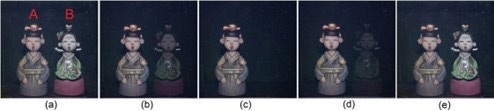
Achieving this feat requires a hologram, cleverly placed cross-polarizers and some special lighting.
The Denisyuk hologram used in the proposed display was recorded on a silver- halide holographic Ultimate U04 3 15×15 cm glass plate, a material specifically designed for recording full-colour holograms without any diffusion, being set to iso- panchromatic for all the common visible lasers used in holography.
In anticipation of its inclusion in the final display, the figurine of the boy was glued off-center in a black box of dimensions 15(h)×15(w)×7cm(d). A full-colour setup combined with beam splitters, a red, green, and blue laser with p-polarization. The red wavelength was provided by a helium-neon laser (633 nm 20 mW), the green by a DPSS laser (532 nm 100 mW), and the blue by a DPSS (473 nm 50 mW). The RGB laser intensities were adjusted to 20 mW to obtain a uniform white laser beam. After processing, a blur-free, realistic, colorful, transparent 1:1 scale image, with high diffraction efficiency for each wavelength was obtained.
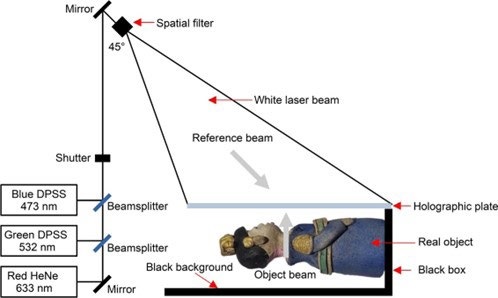
To prevent any emulsion thickness variations (swelling or shrinkage due to changes in humidity or temperature), the hologram was sealed by a second glass plate using optical ultraviolet (UV) glue, which the authors had previously noted would keep holograms protected for several decades.
The assembly
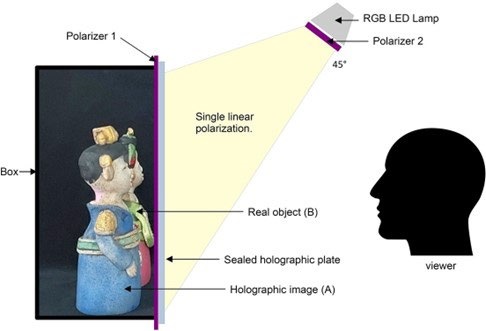
The Korean terracotta figurine of the boy was removed from the box used for recording the hologram and the figurine of the girl (B) was fixed within it. A linear polarizer – that is, polarizer P1 in the figure below – was then fixed in front of the box. The hologram of the figurine of the boy (A) was returned to the same position as it was during the recording. The entire device was then illuminated using an RGB LED lamp through a second linear polarizer – that is, polarizer P2 in the figure below.
The fact that the real object was positioned behind the hologram and that both were illuminated by the same lamp created the illusion for the observer that both figurines were real and shared the same environment.
This feeling was reinforced by the fact that the polarizer reduced unwanted reflections from the real object.
All observations were performed under dimmed ambient light – as in a museum or theatre – without any direct lighting other than the RGB LED lamp.
The illusion
At the beginning of the experiment, polarizers P1 and P2 are parallel and point in the same direction. The light from the lamp illuminates the hologram A and reconstructs it, passing through it to illuminate the real object B. For an observer, both figurines appear to be real and share the same space, as shown in (a) in the figure below.
As the polarizer P2 begins to rotate, the amount of light passing through the polarizer P1 diminishes. Figurine B starts to disappear while hologram A is still illuminated in the same way as in (b). When the polarizers P1 and P2 are crossed – perpendicular – the light beam is extinguished, and figurine B no longer receives any light, disappearing completely. Only hologram A remains visible – as in (c).
As polarizer P2 continues to rotate, figurine B gradually reappears (d) until it finally returns to its original brightness (e).
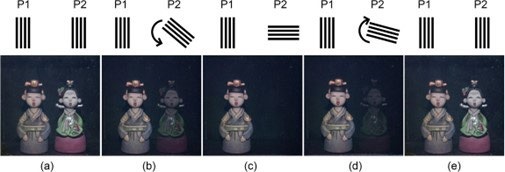 The illusion (© Optica Publishing Group and the authors).
Although the effect was very convincing, the research team admits that to work properly, the illusion has some limitations. If another light source directly illuminates the display, the hologram will be badly reconstructed, and the second polarizer will not be able to make the real object disappear completely.
Moreover, if the light beam of the lamp is stopped – by a hand for example – the hologram is not reconstructed correctly, and the trick is revealed. The size of the hologram, and therefore of the final display, is also limited to the size of the available holographic plates – that is, 60 × 80 cm.
A visualisation of the illusion can be found at: https://opticapublishing.figshare.com/articles/media/Visualization_1_mp4/19884859.
1 - www.tandfonline.com/doi/abs/10.1080/17460650701433517
2 - www.researchgate.net/publication/361808713_True_Holographic_Ghost_Illusion
Subscriber content
Read the full article
Full access to Holography & Optical Technology News articles, newsletters and archives.