
Authenticating in 3D Polarisation

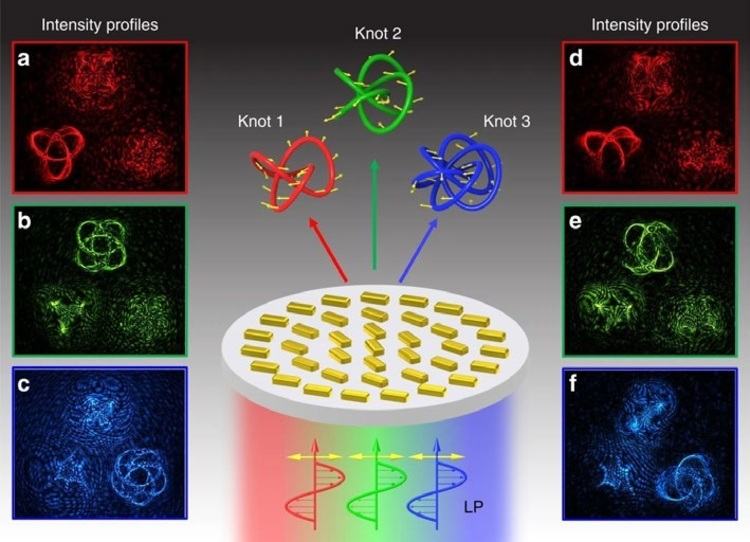
A team of scientists, led by Prof Xianzhong Chen from the School of Engineering and Physical Sciences, Heriot-Watt University, UK, and Prof Shuang Zhang from the Department of Electronic & Electrical Engineering, University of Hong Kong, China, have developed an optical metasurface to create colour-selective 3D polarisation structures.
In a paper 1 published in ‘Light: Science & Applications’, the scientists describe how polarisation, as a central concept to the understanding of optics, has found many applications, including in the field of quantum science, product authentication, and even in our daily lives, in the form of polarised sunglasses and 3D cinema.
While there have been many advances made in the theoretical understanding of 3D polarisation structures, experimental research has not followed at the same rate, explains the paper.
This is essentially due to the technical challenges of creating 3D polarisation profiles with conventional methods (ie. light refraction and propagation), which are only really able to create 2D structures in a transverse plane. As a result, only a small number of 3D structures have so far been generated, but their practical application has been limited by cost, complexity, and the large size of the structures.
This is where optical metasurfaces (see inset) come in. These devices have attracted increasing interest due to their unprecedented capabilities with regard to light manipulation at subwavelength scale.
Optical metasurface-based flat optics (ie. optical elements such as thin-film polarisers, which have a flat surface, as opposed to the usual curved surface of typical lenses), have revolutionised design concepts in photonics, providing a compact platform to develop ultra- thin planar optical devices for novel applications. These include dual- polarity lenses, multi-foci lenses, light sword lenses, and polarisation- sensitive holograms.
The metasurface devices developed by the scientists consist of gold nanorods with spatially variant orientations, sitting on a glass substrate.
Upon illumination of a linearly polarised incident light beam, multiple 3D knots with predesigned polarisation profiles are created. Within a given observation region, only a single 3D knot can be obtained for a single colour (wavelength), with the other knots obtained by changing the incident wavelength. The generated polarisation structures are unveiled through a linear polariser, leading to various modulated intensity patterns.
Three different knots are selected as predesigned polarisation structures, in the same observation region, for the wavelengths of 650nm, 575nm, and 500nm, respectively. Both polarisation and colour information of the three knots are encoded into a single metasurface consisting of gold nanorods. Images a to c (above) show measured intensity profiles upon illumination of a horizontal linearly polarised light beam before and after (images d to f) passing through a polariser. a and d are generated at 650nm, b and e at 575nm, and c and f at 500nm. See image above.
Taking it further
While the maximum number of wavelengths in the colour-selective functionality for this particular development is three, these can be increased by reducing the size of the polarisation structures or by using metasurfaces consisting of nanostructures with different feature sizes.
It is also possible to create 3D polarisation knots with multiple colours. And the capability of simultaneously encoding colour and intensity information into 3D polarisation profiles can produce a ‘3D colour image hidden in a 3D colour image’, whereby the image formed by the 3D structure with predesigned colour and intensity distribution can be changed to another colour image with the aid of a polariser.
This flexible and controllable generation of customised 3D polarisation profiles, based on a lightweight and easily integrated optical system, can open doors to many practical applications such as information security and anti-counterfeiting.
Furthermore, the metasurface devices can be vertically integrated to build a complex system composed of various planar components (eg. gratings, splitters) to perform sophisticated tasks.
‘We expect that this capability will fuel the continuous progress of wearable and portable consumer electronics and optics where low-cost and miniaturised systems are in high demand,’ said the scientists.
Optical Metasurfaces
Optical metasurfaces (OMs) are sub-wavelength patterned layers that interact strongly with light, thus dramatically altering light properties over a subwavelength thickness.
In contrast to conventional optics, which rely on light refraction and propagation, OMs offer a fundamentally new method of light manipulation based on scattering from small nanostructures. Such nanostructures can resonantly capture light and re-emit it with a defined phase, polarisation, modality and spectrum, thus allowing the sculpting of light waves with unprecedented accuracy.
This ability to manipulate light at the nanoscale level has opened a plethora of practical applications, including spectral selectivity, wavefront and polarisation control.
Extracted from Neshev, D, Aharonovich, I. Optical metasurfaces: new generation building blocks for multi-functional optics. Light Sci Appl 7, 58 (2018). https://doi.org/10.1038/s41377-018-0058-1.
1 - Intaravanne, Y, Wang, R, Ahmed, H et al. Color-selective three-dimensional polarization structures. Light Sci Appl 11, 302 (2022). https://doi.org/10.1038/s41377-022-00961-y.
Subscriber content
Read the full article
Full access to Holography & Optical Technology News articles, newsletters and archives.