Structural Colour Gets Special Attention at ODDS 2022

The phenomena of structural colour – when different wavelengths of light are selectively reflected from a substance, with the remaining wavelengths transmitted or absorbed – is gaining increased attention in the security print industry as an environmentally benign method of creating colour without resorting to dyes or other chemicals (see AN August 2021).
Two papers presented in the ‘New Approaches to Document Security’ session of the recent Optical & Digital Document Security™ (ODDS) Conference in Vienna (11-13 April) described research on different approaches to harnessing the effect.
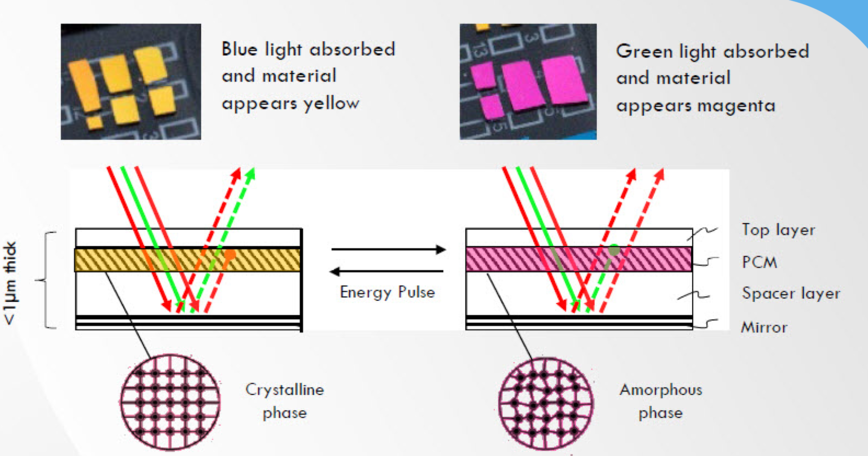
Peiman Hosseini, co-founder and CEO of Bodle Technologies (UK), described a novel switchable optically variable ink (SOVI), which has the capability to switch between two stable, highly contrasting, colour states generated by an optical nano-cavity featuring ultra-thin phase change materials using laser excitation.
Peiman’s work, which had previously been described in an article in Nature 1 titled ‘An optoelectronic framework enabled by low-dimensional phase-change films’, explores how any colour can be generated by light interference in an all solid-state configuration that doesn’t use dyes or pigments. As an example, when the material is designed to absorb blue light, it will appear yellow, and when tuned to absorb green light, the material will appear magenta.
The colour changes when a pulse of energy switches the phase of a PCM (phase change material) layer from crystalline to amorphous. Once the switch has occurred, which takes a matter of nanoseconds, no further energy is required to maintain the colour state.
For secure document applications, a laser writing system is envisaged whereby a document with an integrated switchable- OVD layer is personalised at the point of issue. The angular dependency of the colours created can be integrated into the design of the document and can be arranged to be re-writable.
Bodle was established in 2015 to commercialise optoelectronic technology developed at the University of Oxford. In December 2020, the company secured an extension to its Series A funding round with Oxford Sciences Innovation, Bodle’s backer since inception, leading the investment with support from the UK government’s Future Fund.
The second paper to explore the uses of structural colour for secure document applications was ‘Iridescent Films Utilising Structural Colour from Reflective Microstructures’ from Caleb Meredith, Pennsylvania State University (US).
In his paper, Caleb described a method for making iridescent security films exhibiting tuneable colour-shifting appearances, with wide angular colour separations. In his presentation he demonstrated an optical effect enabling the generation of optical interference from concave reflective microstructures ranging from 10 to 100 microns in size.
Citing a separate article in Nature 2 titled ‘Colour from colourless droplets’, Caleb set out the materials development journey that the research had gone through from 2017 to the present to achieve a new optical mechanism for creating colour-shifting materials using reflective microstructures.
The current fabrication method uses greyscale lithography to master surface topographies of a range of shapes whose dimensions can be varied to achieve tuneable colours.
For secure document use cases, Caleb proposed overlaying transparent films onto printed surfaces, where it was claimed structures in thermoset polymers can be laminated into document card stacks without causing damage.
Caleb is CEO of Chromatir, which follows this approach to colour generation to engineer films of colour-shifting microstructures at scale using existing industrial coating techniques which can be applied to almost any surface.
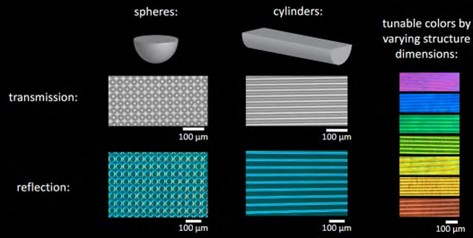 Up-close viewing of microstructures (© Caleb Meredith).
To learn more about these, and all of the presentations from ODDS 2022, follow this link https://opticaldigitalsecurity.com/download-odds2022/ and use the password provided to attendees at the conference to download the presentations in their entirety.
Subscriber content
Read the full article
Full access to Holography & Optical Technology News articles, newsletters and archives.