News in Brief


Holographyx Launches Patented Holo-Blister
Holographyx has announced that it has recently been granted US Patent # 11,052,020 B2 for its Holo-Blister® product, along with European Patent # EP 3532005 for the development of a cost-effective method to apply holograms to the back of blister packs using conventional heat-seal blister packaging equipment.
Holo-Blister holograms have been designed so that they will only be visible behind each pill/capsule cavity on the back of each blister pack, thereby allowing the printing of dosage and marketing information on the area surrounding the pill/capsule recess.
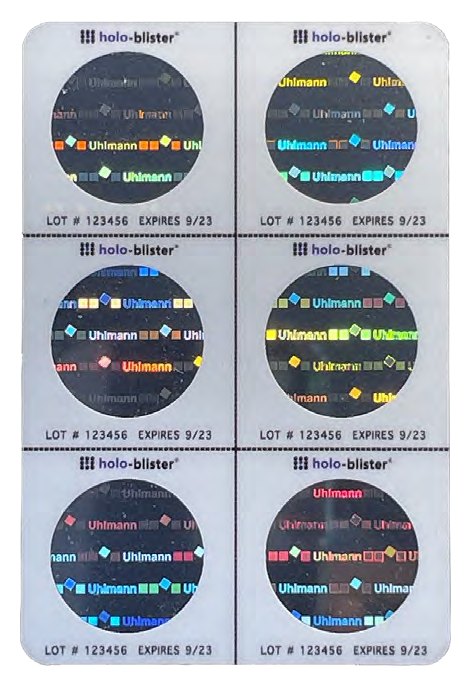 © Holographyx
According to Holographyx, the size of the worldwide market for counterfeit pharmaceuticals has been estimated to be as much as $200 billion annually. Although anti-counterfeiting measures such as track and trace can be used to distinguish legitimate pharmaceutical products from counterfeits, these systems require consumers to go on-line to validate each of their pharmaceutical purchases.
Blister-packaging utilising HoloBlister provides consumers with the ability to visually validate the authenticity of their purchases instantly, says Holography with thex, use of custom holograms that, prior to the development of the solution, would be extremely difficult to manufacture and apply.
Holographyx has been working with the Hazen Paper Company in cooperation with Uhlmann Packaging on the development, testing, and introduction of Holo-Blister.
Patent of the Month
The International Hologram Manufacturers Association (IHMA) Patent Newsletter is a monthly review of patents issued in the fields of security, decorative and data storage holography, along with holographic techniques, processes and displays.
In each edition of the newsletter a ‘Patent of the Month’ is chosen on the basis of its potential impact on the industry.
In January, the limelight shone on Giesecke+Devrient inventors Matthias Pfeiffer and Tobias Satiler for their patent on an optically variable security element. A transcript and figure from the patent reads:
‘The invention relates to an optically variable security element (12 – see fig 2) for safeguarding valuable objects, the surface area of said security element defining a z-axis perpendicular thereto, comprising a reflective surface region exhibiting at least two images (14-A, 14-B) which are discernible from different viewing directions.
The reflective surface region contains two relief structures (24, 34) that are arranged at different vertical levels in the z-direction and form a lower-lying and a higher-lying relief structure, each of which is provided with a reflection-increasing coating (26, 36) that follows the course of the relief.
The higher-lying relief structure (34) exhibits a first optically variable effect in a first colour, and the lower-lying relief structure (24) can be viewed through the higher-lying reflection-increasing coating or through grid intermediate spaces (54) or recesses in the higher-lying reflection-increasing coating (36) and exhibits a second optically variable effect in a second different colour.
The security element is provided in an inner coating which is provided over the entire surface or in some regions (60) and comprises at least one machine-readable feature substance (62).’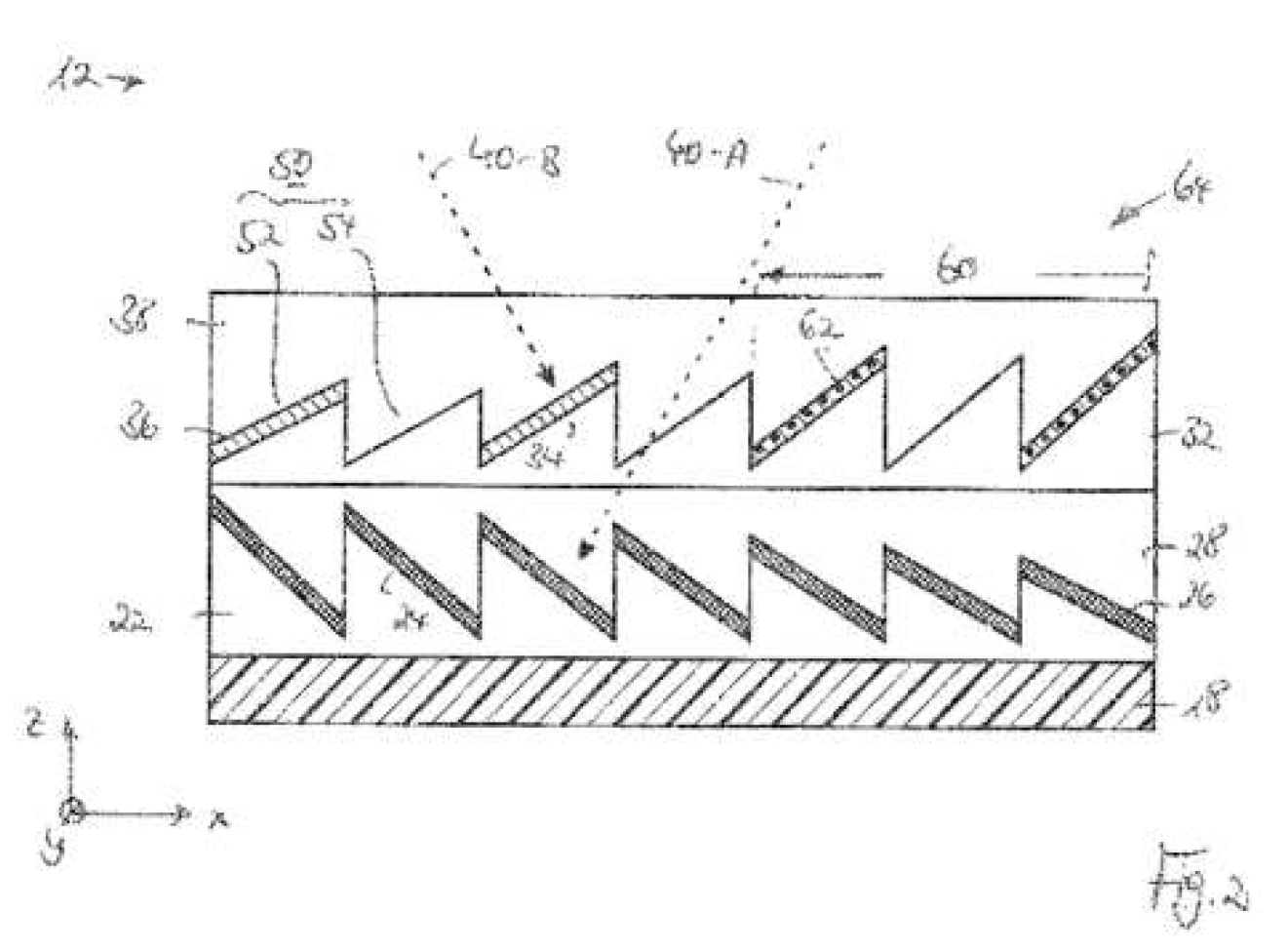
The Patent Newsletter is made available exclusively to IHMA members. To become a member visit https://ihma.org/about-us/#join-us.
Apple Headsets Likely to Adopt Holograms
While we wait for Apple’s rumoured headset with mixed reality capabilities to be unveiled this year, it seems likely that Samsung will take another approach for a future product using holograms. Both companies are competing to get wearable virtual reality (VR) and augmented reality (AR) headsets to market as entry devices to access the Metaverse – the network creating a virtual 3D world.
An article published on ‘Korea IT News’ expects that Apple will release a VR headset terminal for the metaverse market as early as this year, equipped with microorganic light emitting diode (OLED) displays.
Apple collaborated with Taiwan’s semiconductor contract manufacturing and design company TSMC in developing OLED displays for VR devices. Micro OLED displays do not require filters to achieve colour rendition since OLEDs are deposited directly on the chip wafer.
Samsung plans to introduce an AR device that uses ‘hologram’ technology. Samsung Electronics has been preparing for the commercialisation of hologram technology for some time, working over many years with Samsung Advanced Institute of Technology on slim-panel holographic video displays (see HN November 2020).
Samsung is closely co-developing technology with DigiLens, an American AR/ extended reality (XR) technology company. It is reported that Samsung Electronics has completed the development of a prototype and is deciding the release date.
Tetra Pack Launches First Holographic Packaging in India
Tetra Pak, a world-leading packaging and processing solutions provider, has introduced its first ever locally manufactured holographic packaging material in India.
The innovative packaging, called Tetra Pak® Reflect, has been launched in partnership with Warana, a leading cooperative dairy, for their 1 litre ghee (clarified butter) packs. The package is designed to help food and beverage brands add a new eye-catching dimension to their packs. For the first time, the holographic packaging material will be produced at Tetra Pak’s manufacturing site in Chakan, Maharashtra. The Warana Ghee in Tetra Pak cartons will first be available in Maharashtra, with a major focus on Mumbai, Marathwada and Vidarbh.
Ghee is a traditional food in India, linked with purity and richness and in recent years has gained immense popularity. Adulteration of food items, especially edible oil and ghee, is a big challenge in India, and increasing demand for ghee is leading to malpractices like counterfeiting, leading to quality concerns.
Commenting on the launch, Praneeth Tripurari, Marketing Director, Tetra Pak South Asia, said: ‘Ghee is an intrinsic part of the Indian kitchen, and we are pleased to partner with Warana Dairy in bringing safe, authentic, high-quality ghee to the discerning Indian consumers, using our state-of-the-art packaging and processing technology. We are especially proud that the Tetra Pak Reflect packaging material is now being made in India, at Chakan, making it a truly local for local offering.
Subscriber content
Read the full article
Full access to Holography & Optical Technology News articles, newsletters and archives.