
Holography in Medical Training

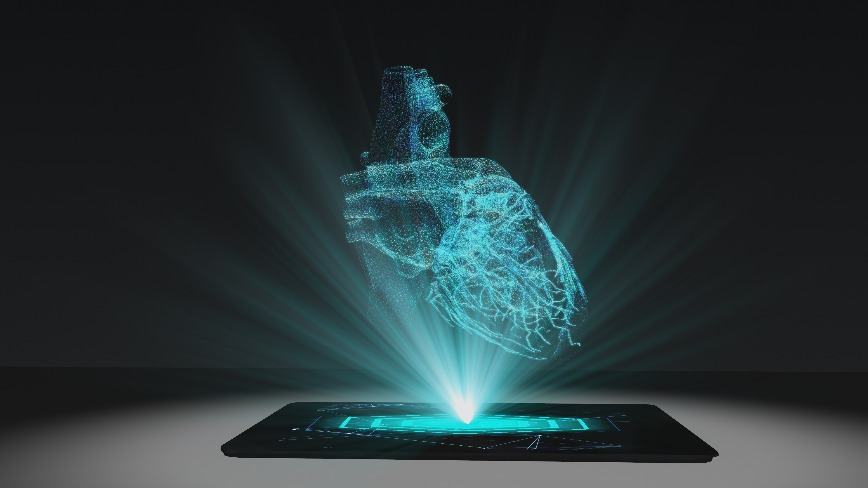
In its predictions for continued growth for holography in 2022 (see HN January 2022), the International Hologram Manufacturers Association (IHMA) pointed to new applications for holography in medical imaging.
Holography is already proving useful in detecting problems in organs such as the heart and brain (see HN April 2021), but in this article, Holography News® takes a look at holography as a training tool in medicine.
Project Polaris in Singapore
The National University of Singapore (NUS) Yong Loo Lin School of Medicine is getting holographic technology from Microsoft to aid its medical and nursing students in learning medical procedures and studying anatomical structures.
Beginning this April, the so-called Project Polaris NUS will be a collaborative effort by NUS Medicine, National University Health System (NUHS), and Microsoft to hone students’ skills through mixed reality training based around the Microsoft HoloLens 2.
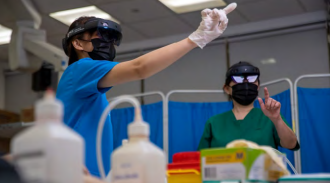 Project Polaris (© Microsoft and NUS Yong Loo Lin School of Medicine).
Under the project, 3D holograms will be projected from the HoloLens 2 that gives a visual presentation of actual clinical scenarios in practice. A joint team from NUS Medicine and Microsoft Industry Solutions has developed several instructional software programmes that help in practising clinical procedures, such as inserting a cannula and catheters.
Alfred Kow, associate professor and the Assistant Dean for education and co-project lead of Polaris commented that ‘We are truly excited to see how far this collaboration with Microsoft can go in terms of offering our students innovative and effective visual aids and teaching mechanisms.’
Polaris builds on NUHS’s ongoing research and development programme around the use of mixed reality tech in clinical care. The healthcare group has already demonstrated a proof of concept where a holographic visor was used to create a 3D hologram of a patient’s brain scan that was projected into space and superimposed onto a patient’s head during surgery.
The hologram was generated using a 3D medical software called Virtual Surgery Intelligence by German medical platform developer apoQlar.
The technology enables surgeons to identify tumours ‘quickly and precisely’ and know their exact location and which angle to make an incision. Surgeons can also view the holographic image from different angles, as well as interact with and control it by gesture and speech recognition.
The hospital group recently said that through its research it wanted to support the creation of new clinical applications that will enhance clinical processes, improve patient safety, and refine medical education. It has outlined a holomedicine roadmap that includes several projects, integrations, procedures to onboard users, and boosting the hospital’s infrastructure to support holographic tech.
‘As one of the few hospitals in Southeast Asia that has a tertiary education arm which collaborates with a training hospital, NUS Medicine is in a unique position to use mixed reality solutions and the Microsoft HoloLens 2 to aid in the transformation of healthcare education, for years to come,’ said Richard Koh, national technology officer at Microsoft Singapore.
Cambridge University Hospital (UK)
A slightly different approach is being pursued for trainee medical students to hone their skills on holograms of patients thanks to a new partnership set up between the UK and the US.
Nurses and doctors also seeking to enhance their clinical skills will be able to use the holographic patients to practice high-level, real-time decision making and treatment choice.
The ‘mixed reality’ technology is thanks to a collaboration between GigXR, an American technology company and Cambridge University Hospitals (CUH) and the University of Cambridge Faculty of Education.
‘Simulating real-world, real-time medical care requires interactive, responsive patients, training tools and evolving scenarios that conventional methods cannot accurately recreate,’ said Dr Arun Gupta, CUH consultant and director of postgraduate education at Cambridge University Health Partners.
‘Mixed reality not only allows us to create patient holograms that will have realistic medical responses to interventions, it also merges the latest advancements in hardware devices, software, remote capabilities and expertise, to scale access to cutting-edge medical knowledge and training tools.’
Instructors will be able to share scenarios, change patient responses and record observations and discussions, while projecting the hologram via a mixed reality headset into any physical training environment, whether a classroom, large teaching hospital, or remote learning.
Learners will be able to access, observe and assess the holographic patient simulations from either a mixed reality headset or a smartphone or tablet.
Subscriber content
Read the full article
Full access to Holography & Optical Technology News articles, newsletters and archives.