News in Brief


Hologram Label Used to Counterfeit £20 Notes
West Midlands Police (UK) have released information on what to do if you think you have come across a fake banknote, after a video was posted online showing a counterfeit £20 on which the hologram stripe had been simulated by a sticker.
The video shows a man removing the sticker off to reveal the words ‘prop note’ and a void where the hologram should be. (So-called ‘prop money’ is produced for use in movies and, although it looks authentic from afar, normally has wording that identifies it as faux currency. It is not illegal to make prop money, but it is illegal to try and use it in place of real money).
According to the Bank of England’s website, ‘in 2021 typically less than 0.0022% of banknotes were counterfeit, that is less than 1 in 40,000 banknotes. Some 103,000 counterfeit Bank of England banknotes with a nominal face value of £2.7 million were taken out of circulation. At any one time, there is around 4.7 billion genuine banknotes in circulation, with a notional face value of £84 billion.’
Floating Hologram Cash Registers Coming to Convenience Stores
Japanese convenience stores are known for being high-tech, but now they’re set to become even more so, thanks to a new trial of non-contact self-checkouts at select 7-Eleven stores.
Dubbed the 'Digi POS' (point-of-sale), the new registers are said to feature the world’s first non-contact/aerial display technology for POS cash registers. 7-Eleven shared a first look at the new hologram registers with a video showing how they work, which you can find here.
The floating touch panel registers were developed as a joint project between six different companies: Toshiba Tec, which created the POS payment system and is responsible for its installation and assembly in stores; 7-Eleven, who will equip its stores with the product and assist customers with its use while also verifying its effectiveness; Asukanet Development, which manufactures and sells plates for aerial displays; Kanda Kogyo Development, which manufactures and sells aerial display modules; Mitsui Chemicals Development, which manufactures and sells the adhesive ‘Structbond’ used for aerial display plates; and Mitsui Bussan Plastic, which is involved in aerial display module sales and development.
The floating register consists of a flat display, an optical element (aerial display plate), and sensor modules to detect finger movements.
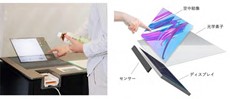 © Toshiba Tech.
The aim of these contactless registers is to reduce the risk of coronavirus infection, although it also has the potential to reduce the workload of staff in the future.
Cheesy Holograms
Nextech AR solutions has signed a deal with Bothwell Cheese which uses Nextech’s ARitize CPG to place QR codes that create human holograms on Bothwell’s cheese labels.
The technology can be found on five Bothwell Cheese products distributed at all major retailers and independent stores across Canada, such as Whole Foods Market, Save-On-Foods and Sobeys.
‘This technology is the future of product interaction with consumers, which distributes product messaging to consumers via hologram in a fun and interactive way,’ Nextech said in a statement.
Without requiring any specialised equipment, the ARitize CPG lets brands easily create interactive experiences with smart packaging for POS, online, and in- home to increase confidence, encourage repeat buyers, and reduce returns.
Announced in 2020, Nextech launched its AR human hologram marketing platform. Formerly known as Genie AR/Genie in a Bottle, this product has been rebranded to ARitize CPG (Consumer Packaged Goods) and is an augmented reality hologram, triggered by a visual anchor such as a QR code placed on product packaging, in-store aisles, or end-cap displays.
Nextech have also filed four non-provisional utility patents for its Aritize 3D and ARitize CAD products for 3D model making, further strengthening its intellectual property position.
Nextech AR said that the latest patent applications are foundational, as they lay the groundwork in preparation for the mass adoption of everything 3D.
Lenticular Screen Used as ‘Invisibility Shield’
We’ve all seen lenticular lens arrays used to simulate 3D images in postcards, point-of- sale and other advertising displays, but now Invisibility Shield Co is using lenticulars to create the illusion of invisibility.
‘Each shield uses a precision engineered lens array to direct much of the light reflected from the subject away from the observer, sending it sideways across the face of the shield to the left and right,’ the start-up writes on their Kickstarter page 1 for the product.
The company’s page goes on to explain that because the lenses in the array are vertically oriented, the vertically oriented strip of light reflected by the subject becomes diffuse when spread out horizontally as it passes through the back of the lenses.
The lenses are very similar to the columns of semi-cylinders on postcards, but instead of light entering and exiting the card at different angles from the front, the light comes from behind the screen.
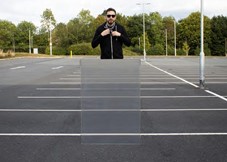 © Invisibility Shield Co.
As it enters the lens array, light hitting the sides is scattered to cover the entire surface, making the image behind it blurry. Meanwhile, the more central light from behind the shield, where the ‘disappeared’ object is (or isn’t?), is reflected so does not pass through the lens array.
The shield is particularly good at maintaining the integrity of horizontal lines, but because the lenses on the shield are vertical, it’s less effective at showing vertical lines behind a person – instead creating a kind of smudge of background light.
The Invisibility Shield is just one of a growing number of research projects into invisibility that have sprung up in recent years – resulting in effects that seem to make waves disappear, including sound and other EM waves outside of the visible spectrum.
1 - https://www.kickstarter.com/projects/invisibility-shield/invisibility-shield.
Subscriber content
Read the full article
Full access to Holography & Optical Technology News articles, newsletters and archives.