
Holography of Increasing Importance to Entering the Metaverse


Previously, Holography News® has reported on the differing approaches that companies are following to manufacture wearable virtual reality (VR) and augmented reality (AR) headsets as entry devices to access the Metaverse – the network creating a virtual 3D world (see HN March 2022).
While some technology companies are pursuing micro-organic light emitting diode (OLED) displays, others are planning to use holographic technology.
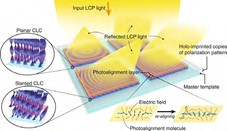 Concept of the holo-imprinting method. © Light Sci Appl and University of Central Florida.
One technique that is currently attracting a lot of attention in this regard is the use of planar liquid crystal (LC) optics as a new type of holographic optical element (HOE) that will be part of the near-eye imaging system.
Besides the ability to record and reproduce arbitrary wavefronts as in traditional HOEs, planar LC optics also exhibit unique properties like polarisation selectivity, dynamic modulation, and large angular and spectral bandwidths. These advantages, combined with their ultra-thin profile and high efficiency, make planar LC optics extremely attractive for next-generation head-mounted displays, including AR and VR, to pursue high image quality, light weight, and compact form factor.
However, to enable a widespread application of the technology, issues surrounding mass production will have to be addressed.
So far, the most common fabrication method for planar LC optical elements relies on lab-scale interferometers for the holographic exposure. This method is excellent for making centimetre-sized samples, but it becomes a bottleneck for large-scale and high throughput industrial manufacturing.
Another fabrication technique for diffractive optical devices – surface relief grating (SRG) – known to many readers of Holography News for its application in the commercialised embossed holography sector, uses nano-imprinting for mass production.
Nano-imprinting usually relies on a high- precision lithography method, like electron beam lithography, to write a master plate and then uses it to replicate copies. Although there are some issues associated with this technique, such as limited lifetime of the master plate and quality of replication, its major advantage of fast processing has led to preliminary success in SRG-waveguide displays.
In a new paper titled ‘Holo-imprinting polarization optics with a reflective liquid crystal hologram template’, published in Light: Science & Applications 1, a team of scientists, led by Prof Shin-Tson Wu from the College of Optics and Photonics, University of Central Florida (USA) proposes a concept called ‘holo-imprinting’, to realise the optical replication of planar LC optics. This method not only demonstrates the feasibility for mass production, but also eliminates the concern of limited master lifetime and imprinting quality due to its non-contact nature.
Traditional HOEs rely on the modulation of light intensity to form patterned fringes, which induces molecular diffusion. Planar LC optics, however, adopts a different mechanism of pattern recording, called photoalignment, which has been widely used in commercial LCD products, such as smartphones and TVs. Photoalignment molecules are extremely sensitive to the polarisation state of light, with linear polarisation producing the best alignment.
The formation of a high-quality linear polarisation field is vital to the holographic exposure process. Previous interferometric methods mostly use two circularly polarised beams with opposite handedness (left and right) to form the linear polarisation field pattern. Wu’s team, however, predicted in the paper that two circularly polarised beams with same handedness could also produce high-quality linear polarisation fields, but these two beams must be incident from opposite sides on the recording sample.
Coincidently, the recently developed reflective planar LC optics perfectly matches this requirement. Such a reflective LC optics is based on cholesteric liquid crystal, which has the self-assembly nature and forms stable helical structures. It only reflects the circularly polarised beam with the same handedness as the helix, so that the reflected light maintains the same polarisation state as the incident light.
Based on this principle, Wu’s team experimentally validated the concept and fabricated samples including gratings and lenses, which exhibit the optical qualities predicted in their analysis. For proof-of- concept, the sample size is around 5 cm, but the team believe that scaling up the template size should be achievable by incorporating techniques such as laser-scanning or multi- area exposure.
Subscriber content
Read the full article
Full access to Holography & Optical Technology News articles, newsletters and archives.