
Eastman’s Journey Puts Holograms Into Windscreens

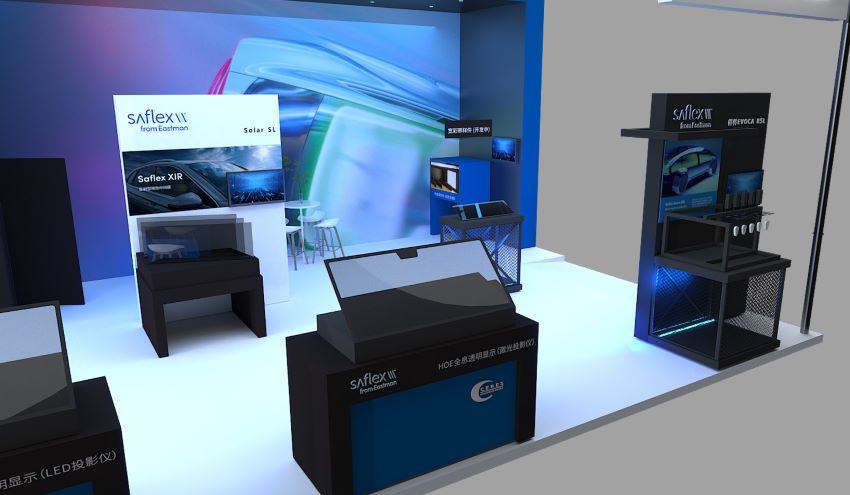
From its origins alongside famous photographic film manufacturer, Kodak, the Eastman name has travelled a long way in holography, all the way to its appearance at Auto China 2026 1.
Early days
Long before laser holography appeared in the 1960s, Eastman Kodak had built a substantial scientific-photography business. By the 1930s, its specialist plates were being promoted for spectroscopy and astronomy, where fine detail, controlled spectral response and stable glass supports were essential. That made Kodak well placed when holography emerged as a new way of recording optical information.
A hologram is not a conventional photographic film which works by recording the amount (amplitude) of light falling on each part of the film. It records the interference pattern formed when light from an object interferes with a coherent reference beam. Kodak Spectroscopic Plate Type 649-F became one of the important early materials for holography because it offered the fine grain and high resolving power needed for this work. These qualities made it suitable for early laser holography, including the landmark experiments by Emmett Leith and Juris Upatnieks at the University of Michigan, which demonstrated high-quality wavefront reconstruction using an off-axis reference beam.
Subscriber content
Read the full article
Full access to Holography & Optical Technology News articles, newsletters and archives.