Scientists Develop Novel Method for Controlling Light Polarisation

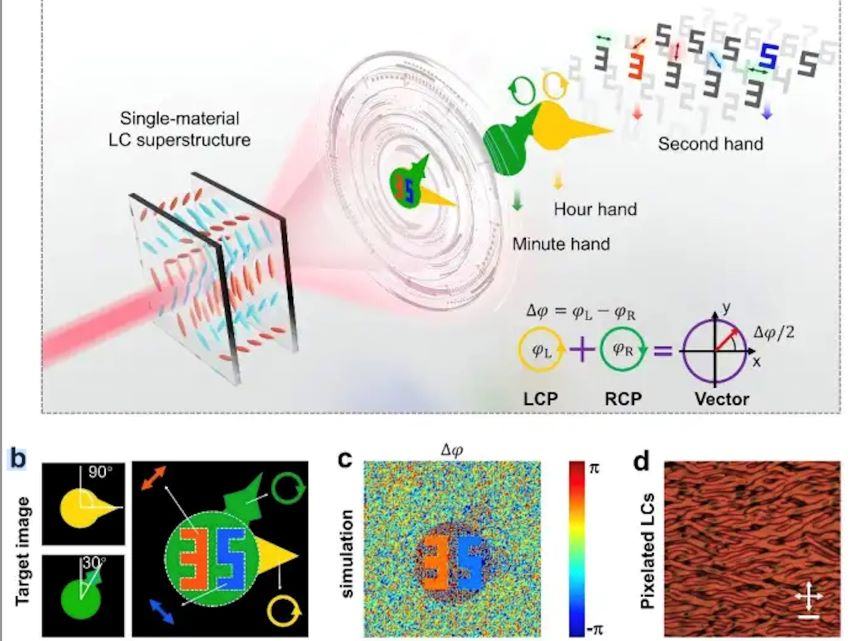
A team of scientists from Nanjing University and Tianjin University in China, and the National University of Singapore, have developed a novel method for controlling the polarisation of light using liquid crystal (LC) holography.
The traditional approach to vectorial holography, which involves manipulating both the polarisation and intensity of light, often relies on meta-surface structures engineered to control light waves. These meta-surfaces are usually static and lack the flexibility needed for dynamic photonic applications such as augmented reality, data storage, and encryption.
This new method overcomes this limitation by employing a single layer of LCs. LCs are known for their ability to change their properties under an electric field, making them ideal for dynamic control. The researchers developed a novel encoding method that allows LCs to display versatile and tuneable vectorial holography, where both polarisation and amplitude can be controlled independently at different positions.
Subscriber content
Read the full article
Full access to Holography & Optical Technology News articles, newsletters and archives.