Then and Now – Financial Cards

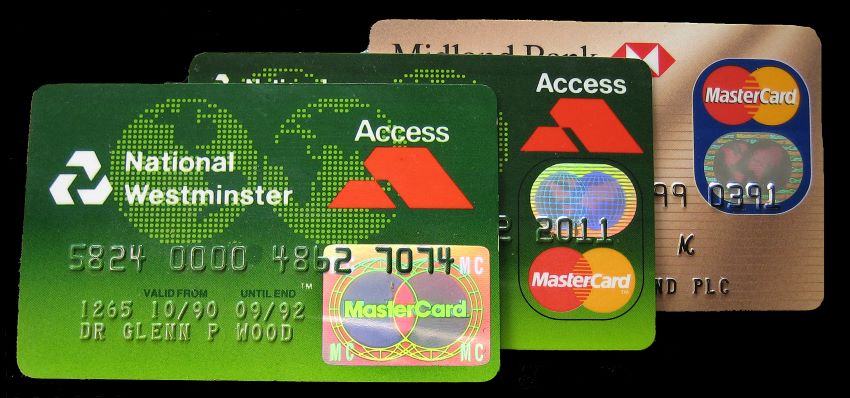
In this series of articles using source material from historical and current issues of Holography News® (HN), along with a few other contextual sources, I have so far covered the development of commercial holography for use on banknotes, ID cards, head-up displays and the graphics arts industry. This month, I turn my attention to its use on financial cards.
Credit cards
From my perspective, the story of holograms on financial cards begins with credit cards – starting with a problem. In the 1970s, the use of credit cards started to gain widespread popularity, offering convenience for stores, efficiencies for banks and, if properly managed, cash flow control for consumers. This newfound convenience came with an unintended consequence: a surge in counterfeit cards and fraudulent activities. Financial institutions were faced with the daunting challenge of ensuring the integrity of their payment cards.
In response to this growing threat, holograms were introduced to credit cards as a security measure. In 1983, Mastercard was the first to use the hologram as a security device on a financial card. The hologram was first used as an anti- counterfeiting device, but it soon became a design tool to help make the cards more aesthetically pleasing and competitive in the market.
Prior to 1983, the credit card industry saw counterfeit fraud double each year, with Mastercard losing $9.1 million in 1982 alone. In the period 1983-87, Mastercard saw its counterfeit fraud actually reduce by 75%. In an October 1991 HN interview with Tom McGraw, Mastercard’s Director of Technical Operations, he asserted: ‘some of our major competitors who were critics in the beginning soon adopted the hologram for their card design and realised comparable results’.
He also warned that the quality and effectiveness of counterfeit credit card holograms was improving. He clearly gave notice to the industry that the technology behind security holograms needed to improve to stay ahead of counterfeiters.
The March 1992 edition of HN proved Tom’s predictions to be correct, when forged Mastercard and VISA cards, with counterfeit holograms good enough to fool merchants and retailers (the acid test) began to emerge in significant volumes in the Far East. The holograms appeared to be embossed from recreated artwork which required sophisticated laser origination, electroforming and embossing operations.
According to reports at the time, the images were very close to the genuine hologram, although close examination revealed some flaws in the design. This particular group of counterfeits represented the fourth generation of counterfeit holograms on credit cards, with all earlier versions being obviously flawed and easy to spot.
Holomagnetics
In November of the same year, HN reported the launch of Holomagnetics, a new credit card security system comprising an embossed hologram laminated to a magnetic ribbon, with encoding and reading assemblies. It was a collaborative venture between American Banknote Holographics, Control Module, and LEONHARD KURZ.
As a replacement for the standard magnetic strip, Holomagnetics was a machine encoding and reading system designed to verify the validity of the card. In particular, it was intended to prevent the copying of data from the magnetic stripe on a valid card to a stripe on a counterfeit or fraudulent card – a practice known as ‘skimming’. It was also seen as meeting the increasingly important requirement of machine readability.
Some years later, Holomagnetics fell out of favour for credit card use. In HN May 2006, VISA explained its decision to stop using the technology. Quoting from an interview published in sister publication Authentication News®, Karen Gullett, Senior Vice President for Global Brand Management, explained that the new VISA branding programme, of which the HoloMag stripe was an integral part, went live in September of 2005 in various locations, primarily outside the US.
By the end of the year, VISA was receiving a limited number of reports that some of the new cards with the ‘shiny silver stripe’ were not working for merchants. In some of these cases, the card was causing terminals to ‘freeze’, requiring a terminal reboot. VISA dispatched teams into the field to analyse the problem and eventually narrowed the cause to electrostatic discharge from the stripe. Despite the removal of HoloMag from the card, VISA directed issuing banks to continue to use the ‘Dove’ hologram.
The VISA Dove and Mastercard Globe holograms still appear as branding elements on their respective cards but have been relegated to the back.
Phone cards
Before the ubiquity of the mobile phone, calls made from outside the home would have been made from public telephone boxes using mostly public sector telecoms networks. In earlier times, there was one payment option: coins. But as telecoms markets started to deregulate in the early 1980s, new entrants to the market brought new ways to make calls on-the-go and a range of ways to pay for them.
One method that gained popularity, for a while, was a stored value or phone card. These cards had a unique identification number that was used to access and authorise the usage of prepaid phone services. The protection of the number on a phone card was essential to prevent unauthorised access and misuse of the prepaid balance.
For a limited time, there was a bubble of activity in the commercial holography sector for the production of holographic scratch-off material to protect the PIN on phone cards. The December 2003 edition of HN reported that Alpha Lasertek (India) and De La Rue Holographics & Tapes (UK) had joined Pura Barutama (Indonesia) to produce scratch-off holograms as a more secure replacement for the usual grey latex-based ink.De La Rue had already positioned its products for the brand protection and telecommunications sectors, while Alpha Lasertek was aiming at the phone cards, gift voucher and lottery ticket markets. Pura had a range of products specifically developed for pre-paid phone cards that were used by phone service providers in Indonesia, producing over 5 million cards monthly.
These scratch-off holographic foils offered more protection for the PIN number (which could equally be used on vouchers or lottery cards) than latex inks. The challenge was to prevent reading of the number by removing the coating and re- covering it, which could be done relatively simply with basic printing equipment.
As transaction instruments carrying a monetary value, these financial cards were susceptible to tampering, unauthorised access and removal of the data, which the telecom companies were keen to prevent.
Today, sophisticated billing mechanisms aggregate the cost of calls made across different networks, negating the need for phone cards, but the holographic scratch- off technology developed at the time can still occasionally be seen on vouchers and lottery cards.
Cheque guarantee cards
Another financial card that has now largely disappeared but, as an article in HN’s September 1989 edition records, was important for building public acceptance of holograms as a security device, was the cheque guarantee card.
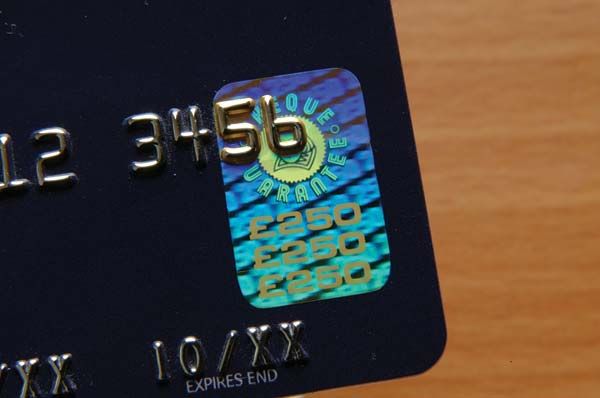
These cards were introduced to minimise the risk of bounced cheques and provided merchants with assurance that the amount stated on the cheque being presented would be honoured – up to the value of the guarantee. It was issued by banks or cheque guarantee companies.
In the late 1980s, British banks launched two new cheque guarantee cards featuring holograms on both the front and back of the card. The new cards were a response to consumer pressure on the banks to increase the sum guaranteed by these cards, which had been held at £50 for over a decade. A three-tier system was introduced, with the two new cards for guarantees up to £100 or £250 issued by special application only.
The holograms were designed and supplied by Applied Holographics (now Opsec) on foil from Crown Roll Leaf. At 18mm x 10mm, the 2-channel holograms featured a background image of the ‘100’ or ‘250’ denomination, as appropriate.
At the top of each was a small seal of Shakespeare’s head, a visual reference to the hologram used on the front of APACS’ (Association of Payment and Clearing Services) cheque guarantee card. The card’s denomination was image-planed on the surface for easy legibility in poor light, while the figure was a real image in the second channel. In a further differentiation, the ‘100’ hologram was on silver foil and the ‘250’ was on gold foil.
Advancements in electronic payment methods and increased use of credit and debit cards have diminished the use of cheques significantly in recent years – and consequently the need for cheque guarantee cards. But the introduction of holograms on the cards not only bolstered fraud prevention but also served as a visible symbol of technological progress in the financial industry. As a result, consumers, merchants, and financial institutions gained confidence in the use of holograms to protect financial transactions, setting the stage for further advancements in the use of holograms as a security technology.
Subscriber content
Read the full article
Full access to Holography & Optical Technology News articles, newsletters and archives.