
Researchers Develop 360-Degree AR Holographic Automotive Display


Researchers from the Universities of Cambridge, Oxford and University College London have developed an advanced augmented reality (AR) holographic system that projects 4K video using LiDAR point clouds, specifically designed for automotive head-up displays.
According to the developers, the technology will significantly enhance road safety by displaying real-time, 3D holographic images that align with real- world objects in both size and distance, providing drivers with a comprehensive view of potential road hazards.
The system utilises light detection and ranging (LiDAR) data, transformed into detailed 3D images, and leverages GPU-accelerated computing to create holograms faster than traditional CPU processing. This offers an augmented view of the road, maintaining the driver’s focus and reducing the risk of accidents due to human error.
Unlike existing 2D head-up displays that project onto a small part of the windshield, the 360-degree technology is intended to keep the driver’s eyes focused on the road. The 3D projections provide information about hazards from any angle in the driver’s field of view without being distracting or overwhelming.
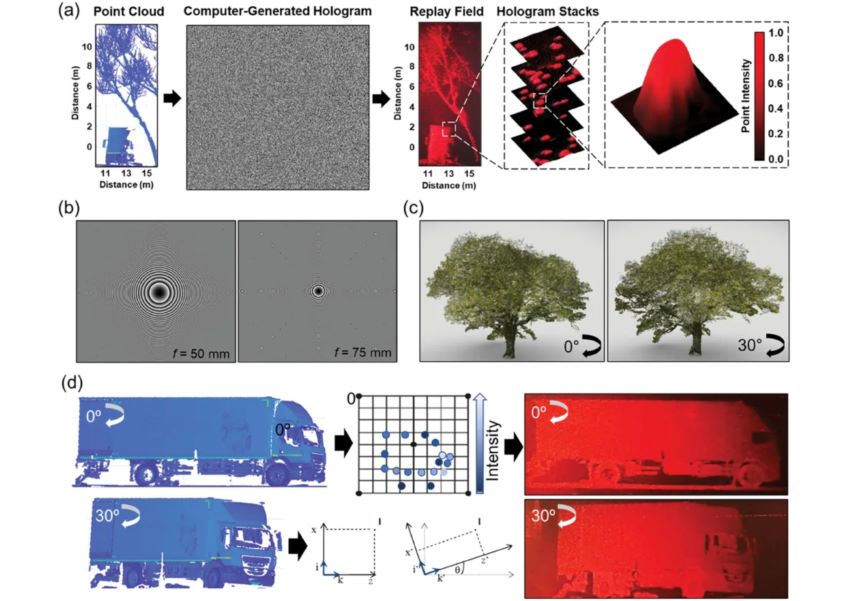
Below is a visual demonstration of the technology.
a)Point cloud-extracted data with a separation algorithm, which is post- processed into a computer-generated hologram and an intensity profile in the replay field result. Each point has an intensity value assigned.
b)The optical focusing lenses are reduced to virtual Fresnel lenses as part of the post-processing algorithm. The virtual Fresnel lenses are introduced at a focal length of f = 50mm and f = 75mm.
c)LiDAR object rotations with depth information as pixel intensity and depth information of the object to be displayed to the driver as a 360°-rotated fully assessable obstacle. The rotation process is shown at 0° and 30°.
d)3D object rotation of the extracted LiDAR object and its corresponding replay field result: LiDAR truck presented at 0°, intensity map of the LiDAR object, replay field result; 3D object rotation around the y-axis, LiDAR image of the truck rotated at 30°; and replay field result.
The researchers used LiDAR to capture extremely detailed scans with up to 400,000 data points for a single object. Specialised data processing techniques extract only the most essential information to generate the holograms in real-time. This allows for a 360-degree assessment of potential obstacles on busy, constantly changing streets.
The data collected can also be stored and shared via the cloud to create a crowd-sourced platform that provides real-time hazard awareness for all vehicles passing through an area.
The researchers are now collaborating with Google to test the system in actual vehicles, with road trials potentially beginning in 2024. The team aims to develop an inclusive system to improve safety for all road users.
 Depth information of the holography setup to recreate 360° floating 3D objects in the replay field (Source: Advanced Optical Materials).
Subscriber content
Read the full article
Full access to Holography & Optical Technology News articles, newsletters and archives.