Plasmonic Metasurfaces Produce Print and Holograms Simultaneously


In the realm of optical technology, a new process is emerging that uses ultrathin plasmonic metasurfaces, capable of simultaneously enabling full-colour printing and holography on a centimetre scale. These metasurfaces leverage photonic spin– orbit interactions excited by surface plasmon polaritons (SPP), opening the door to a new era of high-security applications and mass-produced optical devices.
Traditional metasurfaces, composed of subwavelength structures, have already demonstrated their usefulness in manipulating fundamental properties of light such as amplitude, phase, and polarisation. This has led to the development of various optical devices, including holograms and prints, both looking promising as next- generation optical security and storage solutions. However, achieving simultaneous control of phase and amplitude for large- scale, full-colour printing and holography has been a challenge.
In research conducted across three science academies in China and published in a paper titled ‘Simultaneous Full-Color Printing and Holography Enabled by Centimeter-Scale Plasmonic Metasurfaces’1, a proposed ultrathin plasmonic metasurface overcomes these challenges by employing photonic spin– orbit interactions excited by SPP within a narrow spectral band.
This narrowband response not only facilitates high-purity colour generation but also minimises crosstalk among hologram channels, ensuring the integrity of the holographic images. The metasurfaces encode a full-colour image and three holographic images onto a single metamark, offering versatility in both printing and hologram modes.
Under incoherent white light, the centimetre-scale metasurface appears as a polarisation- and angle-encoded full-colour image, allowing flexible control over hue, saturation, and brightness. In coherent laser illumination, it transitions to multiwavelength holograms, demonstrating the dual-mode capability of the metasurface. This duality is a significant step forward, considering the difficulties faced by previous attempts to achieve both full-colour printing and holography on a large scale.
The key advantage of these plasmonic metasurfaces lies in their ultrathin design, enabling cost-effective mass production processes. The extremely shallow functional layer makes them suitable for surface plasmon lithography and coating processes, both of which are known for their efficiency and scalability. This paves the way for applications in high-density optical storage, holography, displays, and more.
Proof of concept
The proof-of-concept metamark, measuring 1mm × 1mm, encodes a picturesque landscape in the print mode and three distinct images of cartoon images in the hologram mode. Each pixelated plasmonic spin-grating (PSG) in red, green, and blue contributes to a specific hologram channel, forming a vibrant tricolour printing image.
Under incoherent white light, the holographic phase modulation is effectively ignored, and the rotated PSGs act solely as amplitude-modulating colour pixels, revealing the desired printing image.
Optical microscope images using halogen lamps demonstrate accurate colour reproduction, with minimal noise attributed to previous factors.
Upon illumination with coherent laser light, the metamark transitions from print to hologram mode, unveiling independent diffraction patterns for each hologram channel.
The measured total efficiency, approximately 48.2%, slightly lower than simulated values, is attributed to black areas representing about 10% of the metamark, which contribute nothing to the holograms.
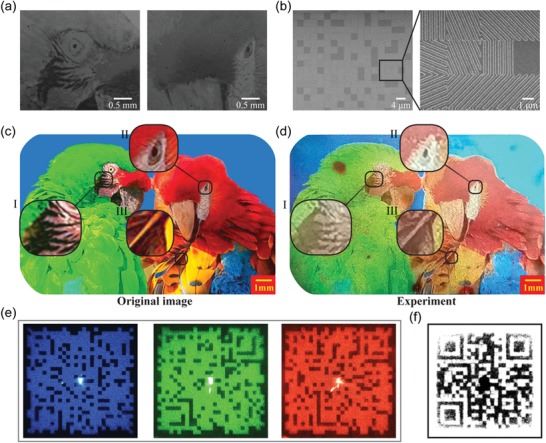
Simultaneous Full‐Colour Printing and Holography, published by WILEY‐VCH Verlag GmbH & Co, KGaA, Weinheim.
Future applications
The proposed metasurfaces might also find applications in high-security domains, offering a platform for embedding multiple types of independent information into a single metamark. This includes information encoded in light parameters such as amplitude, phase, and polarisation. The metasurfaces show promise in anti-counterfeiting measures, information security, and other areas where multifunctional optical devices are in demand.
Subscriber content
Read the full article
Full access to Holography & Optical Technology News articles, newsletters and archives.