Holographic Technology Helps Find Needle in a Haystack


Researchers at MIT (Massachusetts Institute of Technology) 1 have invented an augmented reality headset that uses holographic principles to allow humans to ‘see’ through opaque surfaces. The invention, dubbed ‘X-AR’, combines wireless sensing with computer vision and a floating holographic sphere to enable users to see hidden items.
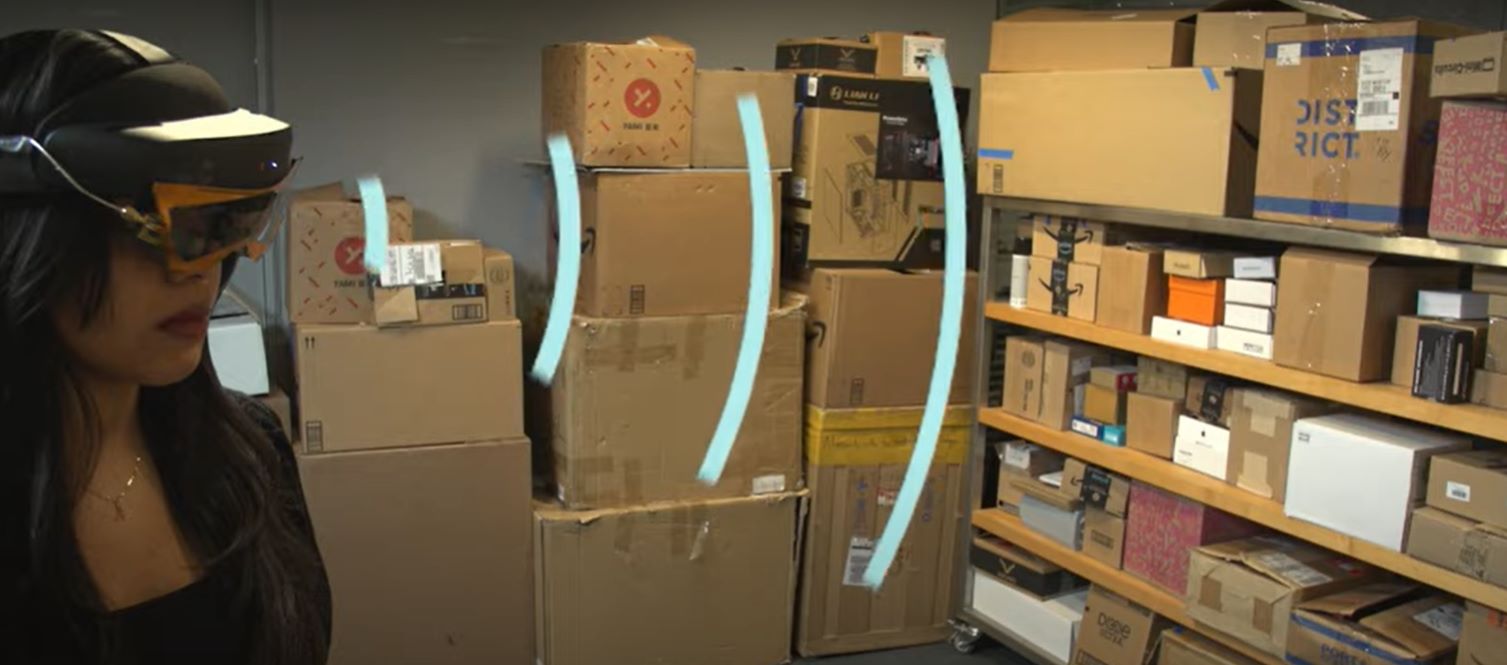
X-AR (© MIT).
This new invention relies on a new flexible conformal antenna. The researchers designed the antenna to fit on the Microsoft HoloLens without blocking any of its cameras and sensors. The system leverages RFID tags that are battery-less, cheap and already deployed on billions of items such as apparel, consumer products and inventory items.
First, the user can choose the item that they would like to find in the inventory, for example a specific T-shirt. In order to find hidden items X-AR sends wireless signals that power up the RFID tags in the environment. The tags then respond back with their unique identifier even when they’re inside boxes or behind other objects. X-AR creates a virtual 3D map of the environment. As the user walks around the scene, X-AR tracks the headset’s trajectory and combines it with RF (radio-frequency) measurements to estimate the location of the RFID tag. X-AR uses the natural head motion of the user to take measurements from various locations and narrow in on the position of the requested item.
When X-AR is confident of the location of the item, it is visualised on the user’s AR glasses. X-AR places a spherical hologram around the estimated location, and a floating arrow appears in order to guide the user towards the localised tag for object retrieval. The arrow is programmed to float slightly above the user’s eye level at a fixed distance in front of them. For every frame update, the application queries the location and rotation of the user in the real-world space. It then computes their directionality to update the pointing vector of the arrow to properly guide the user towards the target object.
X-AR then uses the hand tracking technology of the HoloLens and combines the RF measurements with the trajectory of the user’s hands to verify if the correct item has been picked up.
The researchers believe the technology has many industrial and retail applications in warehouses, where it can boost efficiency by guiding workers in restocking inventory and packing orders.
1 - www.mit.edu/~fadel/papers/XAR-paper.pdf
Subscriber content
Read the full article
Full access to Holography & Optical Technology News articles, newsletters and archives.