
Then and Now – Holography and the Graphic Arts


In the August Holography News® (HN) edition of ‘Then and Now’, I highlighted the role that holograms have played in protecting banknotes from counterfeiting. Looking through the archives of HN I note that at about the same time as the first hologram on a banknote was reported there was an article titled ‘Upper Deck Hits Home Run with Holography’ which told one of the many stories about applications of holograms on trading cards – a phenomenon that took the US by storm in the late 1980s early 90s.
It may be hard to believe now, but at that time the use of holograms in the graphic arts industry was driving innovation in terms of holographic techniques and materials at least as much, if not more than, security print applications.
Magazines
Even before holograms started appearing regularly on premium edition trading cards, they had graced the cover of several editions of the popular science magazine – National Geographic.
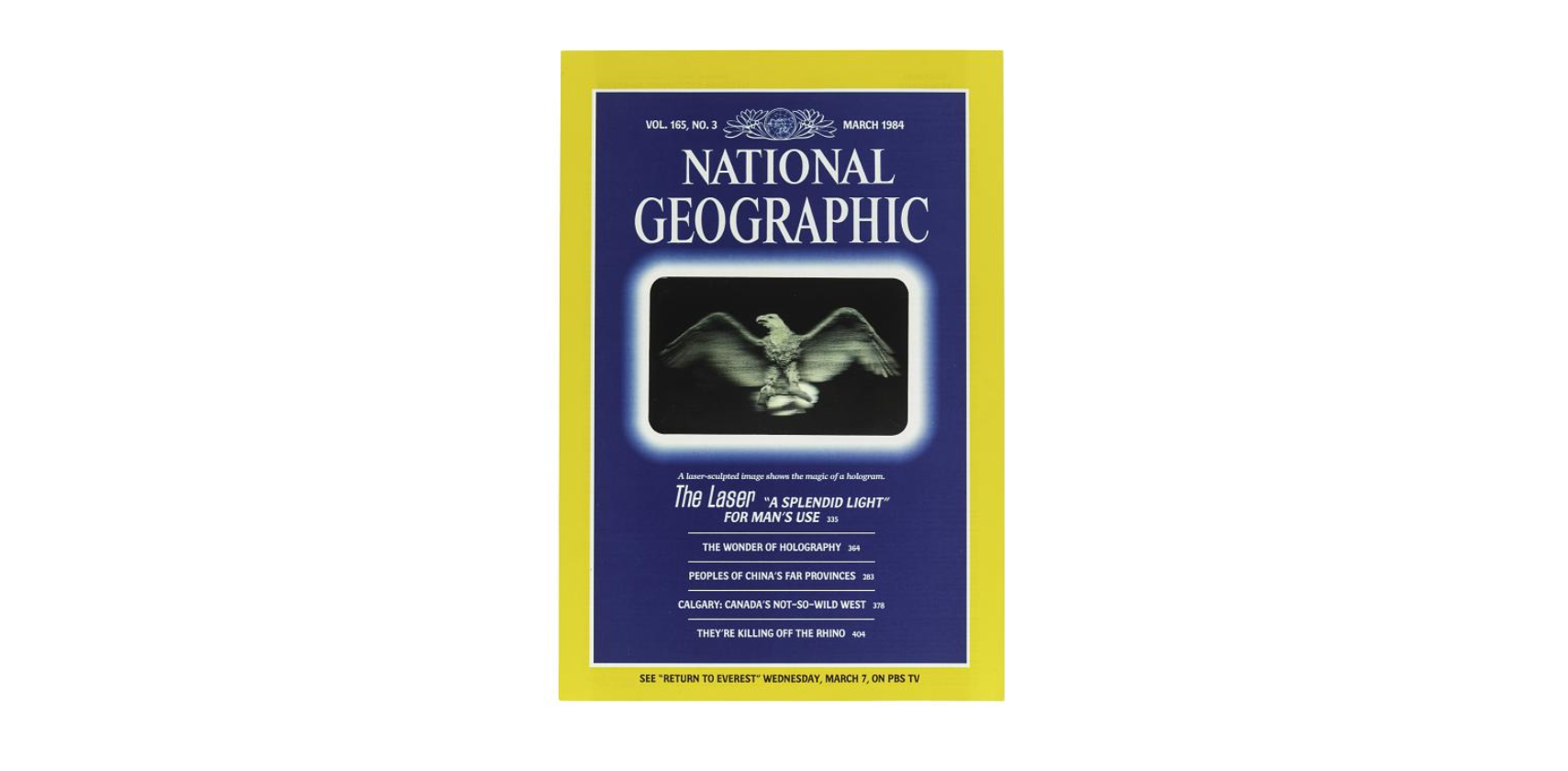
The March 1984 1 issue of National Geographic featured a hologram of an eagle on the cover. The issue pushed the printing and application capabilities of the nascent holographic industry to its limits, as such a large print run (estimated at 10.5 million 2) was unprecedented for holograms.
A year later, ‘The Search for Early Man’ design on the cover of National Geographic depicted a holographic image of Africa’s Taung child 3.
The December 1988 edition 4 of the magazine had as its cover the question ‘Can Man Save This Fragile Earth’, with a full rainbow embossed hologram as its graphic. The back cover ran a McDonald’s advert depicting holographic ‘golden arches’.
One person who was involved in these early breakthrough projects that saw holographic images adorn the cover of magazines with international distribution was Brad Hilbert, who was an active member of the board of the International Hologram Manufacturers Association (IHMA) until he retired in 2021.
I interviewed Brad for HN (August 2021), and he told me that his career started in the graphics hot-stamping foil industry before embarking on a new career with American Bank Note Holographics. His final career stop was with Crown Roll Leaf, from where he joined the board of the IHMA. Brad, like the technology and market know-how of the time, was part of the movement of people and ideas that moved back and forth between graphic arts holography and security print holography.
Greeting cards
You might imagine that holograms and greeting cards would make perfect partners; and around the same time as National Geographic was successfully deploying 2D and 3D holographic images on its covers, Hallmark was testing the water with the roll out of a range of new holographic greeting cards 5.
The series of six cards, which included 3D goldfish, treasure chests and ships, came out in spring 1984 and was intended to be a prelude to a line of holographic gift items.
The two factors that held back the success of holograms on gift cards and wrapping paper are the same that limit the use of diffractive optics on greeting cards to this day: cost and lighting.
Regarding the question of cost, Hallmark, which would not disclose figures, did say the price tag for artistic and mechanical development of the holographic card line was seven times higher than for other card series.
At the time, Steve Crews, Marketing Communications Director for Hallmark, said that he envisioned that costs would go down in time but that holographic cards would probably always be more costly to manufacture than others.
The other matter of concern was to do with the viewability of holograms in stores. To get as close to a perfect image as possible, holograms must be viewed under tightly controlled lighting conditions with as little extraneous illumination as possible. Ideally, the light needs to be a point source at a specific angle and distance from the display if the graphics are to be visible on store shelves and magazine racks. It would also need to have been sheltered from the harsh fluorescent lighting that was prevalent in stores at the time.
Hallmark designed a special display for its holographic cards, but inevitably each card sat at a slightly different angle to the lamp. ‘At least one card will be in a position to pop out at you, wherever you’re standing, said Don French, Product Manager at the time. ‘That should prompt people to pick it up. But without adequate lighting we still won’t have an optimum display.’
Graphics arts today
There can be little doubt that today’s security print applications for holography far outweigh those in the graphic arts industry, but there are still many examples where, if cost and lighting can be controlled, holography is still delivering attention grabbing imagery.
For more than 10 years, Hazen Paper has worked on the Enshrinement yearbook cover for the Naismith Memorial Basketball Hall of Fame. This year, for the 11th Enshrinement yearbook, Hazen used their HoloJet® paper to project an amplified refractive three-dimensional image of a basketball symbolizing the Hall of Fame dome.
For the equivalent 2021 Enshrinement yearbook, Hazen’s edgeless Hazen-Lens technology was used to create a play of light, in front of a brilliant radial burst of two-channel holography, which refracts ambient light to generate the impression of movement as the book is opened (see HN September 2021).
I finish this trawl through the annals of graphic arts coverage in HN, and other sources, where we started – with holographic trading cards and their intrinsic resell value.
Pokémon cards remain extremely popular, with rare holographic cards often going for tens of thousands of dollars at auction houses (see HN July 2023). Recently, a Charizard #4 first edition base set rare hologram trading card sold for over $105,000, while a Secret Super Battle No 1 Trainer hologram promo trading card went for $90,000!
1 - https://americanhistory.si.edu/collections/search/object/nmah_713865
2 - www.nytimes.com/1984/02/20/business/holograms-find-market-on-magazines-and-cards.html
3 - www.etsy.com/listing/484069693/holographic-cover-1985-national
4 - www.amazon.com/National-Geographic-Magazine-Fragile-hologram/dp/B000NGQQFY
5 - www.nytimes.com/1984/02/20/business/holograms-find-market-on-magazines-and-cards.html
Subscriber content
Read the full article
Full access to Holography & Optical Technology News articles, newsletters and archives.