IHMA Services

Patent of the Month
In April 2023’s edition of the International Hologram Manufacturers’ Association (IHMA) patent newsletter more than 80 patents are listed, among them a method for anti-counterfeiting printed material from the National Printing Bureau (Japan).
The objective of the patent is to provide an anti-counterfeiting printed material capable of achieving gray scales in excess of 75% with respect to a visible image formed from a photo luminescent ink. The printed material exhibits a high image change effect, even when high quality paper is used as a substrate, and also exhibits high resistance to counterfeiting.
The patent claims that the invention provides a printed image having a different colour to that of the base material on at least one portion, wherein the printed image includes a second image having a light-dark flip flop property formed at an area ratio of 20% or greater using an ink that is the same colour as, or transparent to, that part of the base material.
A first image is formed from a photoluminescent ink having a colour different from that of the base material is superimposed on a second image.
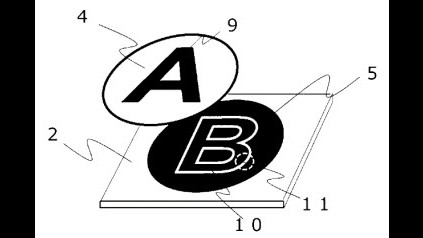
Anti-counterfeiting printed material (© National Printing Bureau).
Also of interest to Holography News® readers involved in security print will be the publication of a patent for a multilayer structure for protecting identification documents from Goznak.
The substance of the patent is a group of inventions relating to a multilayer structure for protecting the documents and to identify the documents in the form of a passport book. The structure itself includes a removable base film, on one side of which are successively applied: a separating layer with an embossable layer with a diffractive protective element, a demetallised layer of aluminium, copper or nickel with local opaque zones, a reflective layer of zinc sulphide or indium oxide – tin, a printing ink layer and an adhesive layer for fixing the structure to the document. The thickness of the adhesive layer can range from 0.2 to 12 microns, and the thickness of the embossable layer with a diffractive element ranges from 0.1 to 10 microns.
The claim is that the invention improves the reliability of document authentication by increasing the brightness of the imagery being restored, as well as increasing the speed of document processing.
The Patent Newsletter is made available exclusively to IHMA members. To become a member visit https://ihma.org/about-us/#join-us.
Subscriber content
Read the full article
Full access to Holography & Optical Technology News articles, newsletters and archives.