12th Display Holography Symposium

The 12th International Symposium on Display Holography (ISDH) took place in Seoul, South Korea, from 26 June to 1 July. This was five years after the previous Symposium, breaking the three-year cycle, for obvious reasons to do with COVID and travel restrictions.
However, the intention now is to hold the 13th Symposium in three years’ time, not next year.
The buzz of holographers
The event was co-chaired by Hans Bjelkhagen, who took on the task of continuing the work of the late Tung Jeong (TJ), the founder of the ISDH, and Prof Seung Hyun Lee, of Kwangoon University, the hosts for the event, which made Prof Lee the local organiser, ably supported by staff and students.
There were around 130 participants, over half of them from South Korea, and around 60 from other countries, with typical attendance at the presentations hovering around the 60-70 mark. People from outside Seoul were accommodated in a number of hotels around the Sofitel Hotel, the event venue, which meant that the usual easy socialising which has been a feature of this symposium did not take place, as participants went their own way for evening meals.
Nonetheless, there was the usual buzz between holographers during the refreshment breaks and the two group dinners, the first day welcome and the last day farewell meals.
Discussion focused on the presentations – of course – but also on the holograms in the accompanying exhibition. These ranged from pieces demonstrating the capabilities of some of the items covered in the papers to true artworks. Several of these were classic display holograms, but many were digital holograms, made using computer-driven exposure systems.
Competition
Several of these digital holograms were produced on the Gentet brothers’ Chimera hologram camera. This followed the innovation of a competition for holograms produced on the Chimera system. Artists were invited to submit a proposal for a Chimera-produced hologram; a dozen were selected for production by a small panel of judges, which were shown in the exhibition.
At the farewell dinner three of these artists were presented with awards for their pieces.
Setsuko Ishii, the veteran Japanese artist, was awarded for her work titled ‘Eatable?’, a still-life of a pile of fruit and vegetables with remarkably accurate colour reproduction, while the second judges’ award was to Maria Isabel Azevedo for ‘The Portuguese Navigator’, a portrait of Vasco da Gama using an early sextant.
The third award, chosen through a secret poll of attendees, went to Ionna Pioaru for ‘Portrait of Empress Min’, ironically (given Chimera’s colour capabilities) a monochrome portrait of the Korean Empress – full name Myeongseong of Joseon – with the artwork created in Tilt Brush (see HN July 2022 for a full description of Ionna’s technique).

Setsuko Ishii’s ‘Eatable?’. Produced on the Chimera digital image capture system.
In addition to artworks from Setsuko Ishii, Pearl John, Ray Park, Jungwook Kim, Shuo Wang and Jaeeon Byon, the exhibition included holograms demonstrating the capabilities of digital hologram exposure systems from Kwangoon University, KETI Hologram Center and the Hologram Contents Service Center.
It also featured holograms made by Yves and Philippe Gentet on the Chimera system, as well as analogue holograms from both of them and portraits of Yuri Denisyuk and August Lumiere showing Philippe’s colourisation technique.
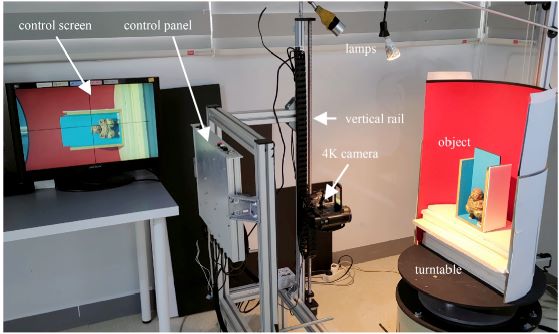
The Chimera Digital Image Capture System.
To acquire a series of perspective images of a 3D scene in the Chimera system, a 4K camera rotates on a 180° semi-circle around the 3D scene to record a series of 768 horizontal images. The procedure is then repeated at 192 levels of elevation, thanks to the vertical rail, to create a cylinder of points of view (see HN January 2023).
The papers
There were 58 papers presented (including a last-minute addition about Lippman photography by Hans Bjelkhagen), arranged in seven tracks: art concepts and techniques (11 papers); colour holography (3); electronic, digital and computer-generated holography (21); history, culture and education (11); recording materials and processing (2); technical applications (7), and the business of holography (1). There were also three presentations by artists giving the background to their work in the exhibition.
It can be inferred from the above short description of the exhibition and the fact that there were 21 papers in the electronic track that computer-generated holograms were a major theme of the event.
The Chimera system featured heavily: an invited paper from Yves Gentet was specifically about the system, but one or both Gentet brothers were named authors in several other papers, and there were numerous references to this system in papers from other holographers who had used it.
Additionally, David Brotherton-Ratcliffe presented a paper about the EcHoLas, a compact direct-write digital holography printer, being developed by a consortium of Geola, Pantec Biosolutions and the Ferdinand-Braun-Institut, with funding from the EU, while he also presented an update on direct-write digital holography at Geola.
Nam Kin presented a paper on depth estimation content generation for a holo-printing system on behalf of three Korean universities – Chungbuk National University, Wonkwang and Incheon National.
Alkis Lembessis of the Hellenic Institute of Holography gave a paper reporting on further developments of the ZZZyclops, the mobile colour holography recording system used to create very faithful holographic reproductions of museum pieces, which are termed OptoClones (See HN July 2021 for more on OptoClones).
He also mentioned the 2019 Magic of Light exhibition in Shanghai, which had attracted 440,000 visitors, a now rare example of a blockbuster hologram exhibition. This was mounted at the Shanghai Science & Technology Museum through the Light Alive project of ITMO University (St Petersburg, Russia) and the Hellenic Institute.
The single paper within the Business track was an unveiling of Zeiss’ project for ‘the industrialisation of micro-optical and holographic projects’, authored by Stanislovas (Stas) Zacharovas and Christoph Erler. Stas, well-known within holography for his work at Geola and as the author of the fourth edition of the late Graham Saxby’s ‘Practical Holography’, joined Zeiss Microoptics earlier this year.
This project aims to establish a production chain for photopolymer volume holograms, starting with both analogue and digital origination, through replication machines for free-space, edge-lit and waveguide holograms, all in cleanrooms and capable of producing at least 100,000 copies of each master (or sub-master) annually. Target markets are initially the automotive, consumer and home technology for display, augmented reality and optical control.
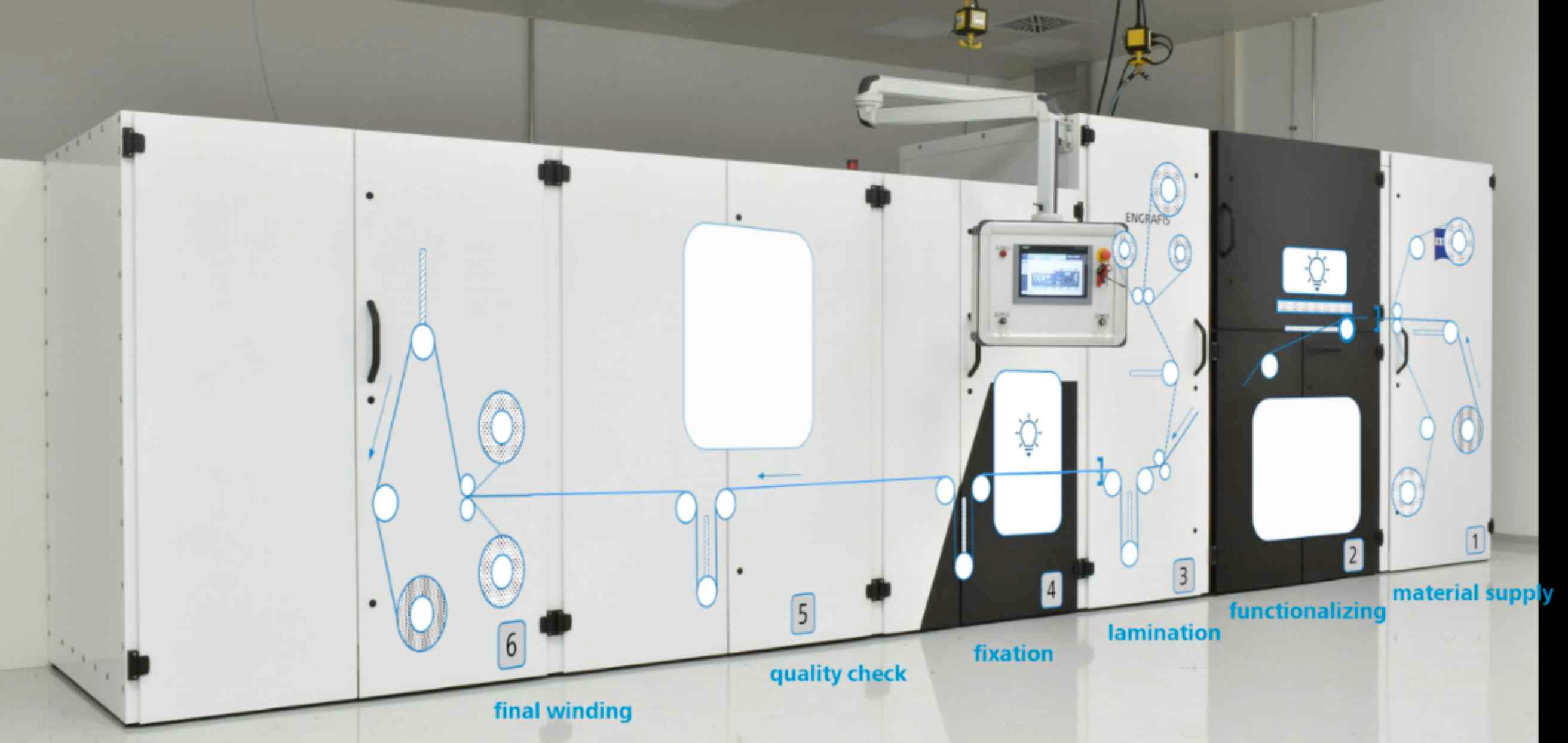
Production for photopolymer holograms (© Zeiss).
Nostalgia was represented by four papers: Hans Bjelkhagen gave a review of the early days of holography in Sweden, ably complemented by Jonny Gustafsson’s paper about Nils Abramson’s contribution to holography. Gustafsson is from the Royal Institute of Technology in Stockholm, Abramson’s home for most of his professional life, so he is well-placed to remind us of his Light-in-Flight and other cutting-edge experiments.
Zsofi Valyi-Nagy, of the National Gallery of Art in Washington DC, presented a paper titled ’A call to arms: Margaret Benyon’s anti-war holograms‘, in which she explored the background to and the content of this early holographic artist’s series of anti-war pieces.
Then on the final day Ian Lancaster (author of this review) gave a paper summarising his career in holography, concluding with his view on the prospects for display holography today. Which is that despite the many exciting developments, as reported and seen at this ISDH, correct lighting is crucial for the presentation of display holograms and until it becomes simpler to achieve then display holography will remain a niche medium.
This was undoubtedly an ISDH worth waiting for, as evidenced by the discussions about where the next one should be! So watch this space…
The proceedings can be accessed at http://isdh2023.kr/.
Subscriber content
Read the full article
Full access to Holography & Optical Technology News articles, newsletters and archives.