
HoloCenter Moves to Kingston, New York – A New Era
Holography News™ has been a keen follower of the formation and progress of the HoloCenter (see HN March and May 2021). With news of the center’s relocation and activities, Executive Director Linda Law brings us up to date with all that’s happening on the art’s scene in the US and beyond.
The HoloCenter has relocated to Kingston, New York, a vibrant city undergoing an arts renaissance. With the loss of our base on Governors Island in New York City during the pandemic, the decision was made to move the HoloCenter to Kingston.
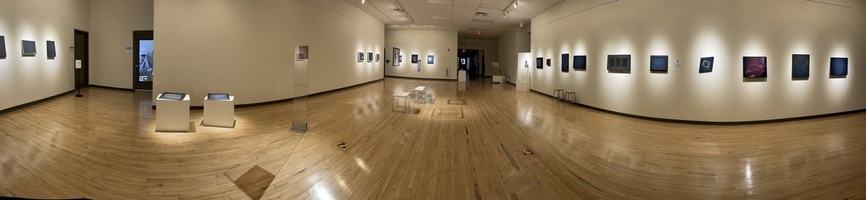
Now with a temporary home at the Cornell Creative Arts Center, we have an office and the use of their large, beautiful gallery for an exhibition of Fine Art Holograms, from 16 September–1 November. This show features the artists who have been a part of the HoloCenter and other venerable holographic artists who will be teaching courses with us.
They are our co-founder, Ana Maria Nicholson, our previous director, Martina Mrongovius, Betsy Connors, Melissa Crenshaw, Eva Davidova, Jaques Desbiens, Peter Miller, Sam Moree, August Muth, and Ikuo Nakamura.
The opening reception was an amazing event with over 100 people in attendance.
As we look for our permanent location in the city-designated Midtown Arts District we are exploring spaces that will provide the HoloCenter with a gallery, a stable basement with room for numerous holographic labs to house our artist-in- residence program, a teaching facility, our offices, space for safe storage of our collection of fine art holograms and an experimental studio to house our digitization system for the Virtual Museum of Holography.
To help finance this endeavour we are seeking grant funding, have launched a membership campaign (https://holocenter.org/membership), and we are looking for corporate sponsorship from the many companies that make up the holographic security industry.
As a result of continuing closures, we are in dire need of a teaching facility with experienced instructors. We frequently receive requests from young artists looking for instruction in the techniques of holography and access to facilities.
This sad situation is ultimately a result of the loss of silver halide materials during the 1990s. In the 1970s we began with holographic film and plates produced by Kodak and Agfa, who were initially supplying holographic materials for researchers and artists. These were later joined by Ilford and Fuji, and Polaroid was exploring photopolymer emulsions for mass production.
These excellent materials were available at that time with either red sensitivity for Helium-Neon and pulsed ruby lasers or green/blue sensitive plates and film for Argon and Nd:YAG lasers. There were no commercially available panchromatic emulsions available then.
The loss of this manufacturing capability was due to the shift to mass production of holograms using photoresist for mastering and the subsequent reproduction occurring on a variety of foils and substrates. Silver halide emulsion manufacturers had no significant market for their products.
Initially, the Shearwater Foundation bought up the remaining Agfa film and gave it to the holographic artists who requested it. Some Agfa film and Fuji materials were hoarded by artists, but creative production of holograms slowly declined. One by one the schools shut down facilities, largely due to the lack of materials and the sad loss of key holographic pioneers.
So, now we are in a new era. With the latest developments in photopolymer materials, growing use of dichromated gelatin emulsions, and the availability of new high-quality panchromatic silver halide emulsions, we again have materials to work with. This is accompanied by the growth of the diode laser industry, with increased improvements in power, range of wavelengths, coherence and stability.
As a result, a door is opening for artists to restart their creative explorations in our amazing dimensional medium.
Photopolymer combined with the Yuri Denisyuk type single beam recording technique is a great way to begin making holograms and to teach entry level courses.
Panchromatic emulsions and inexpensive diode lasers in a range of wavelengths open the door for full color imaging.
Dichromated gelatin hand-coated emulsions combined with single beam recording techniques make it possible to produce bright, efficient, multi-color images with a very wide field of view.
Commercial printing facilities for computer generated holograms provide a means for skilled computer graphics artists to make holograms.
New techniques in photogrammetry and in virtual reality are opening a door for the easy capture of real-world data and art created in VR programs that can be printed with these techniques.
For now, we are spreading the word via our online seminars which reach a global audience (the most recent was on 20 November with the artists who participated in our recent exhibition), our online courses have restarted with ‘Understanding Holograms’ taught by Linda Law (www.lindalawfineart.com/online-courses-1) and our newsletter, which we now publish at least bi-monthly (https://holocenter.org/membership).
Join us and participate in the growing creative community that is still passionate about holography. Our creativity will inspire your commercial ventures and our art should be on the walls of your corporate boardrooms – we are pioneering the next wave of creative dimensional art!
For more information, please contact Linda Law at [email protected].
Subscriber content
Read the full article
Full access to Holography & Optical Technology News articles, newsletters and archives.