Polarization Holography – a New Field of Holographic Research

In conventional holography, the polarization of the reference and object beams are arranged to be co-linear to achieve the maximum contrast of the interference fringes formed and record the greatest amounts of amplitude and phase information from the original object wave.
A field of holography that is receiving increasing interest looks at the effect of various polarization changes on the linear and nonlinear polarization characteristics of reconstructed waves under continuous exposure and during holographic recording and reconstruction.
The advances being made are largely due to the development of tensor theory that primarily focuses on the interaction between polarization waves and photosensitive materials. The practical applications for polarization holography are in holographic storage technology, multichannel polarization multiplexing, vector beams, and optical functional devices.
A review article recently published in Opto- Electronic Science, titled ‘Linear polarization holography’1, reviews and summarises the development of a basic component of polarization holography (linear polarization holography) based on the achievements of research teams across the world in recent years.
The research team of Prof Xiaodi Tan (the corresponding author named on the paper) from Fujian Normal University, is one of the earliest teams to carry out research in polarization holography. Based on the vector characteristics of polarized waves, they proposed the concepts of faithful reconstruction effect (FRE), orthogonal reconstruction effect (ORE) and null reconstruction effect (NRE) and analysed the formation conditions and internal mechanism for each.
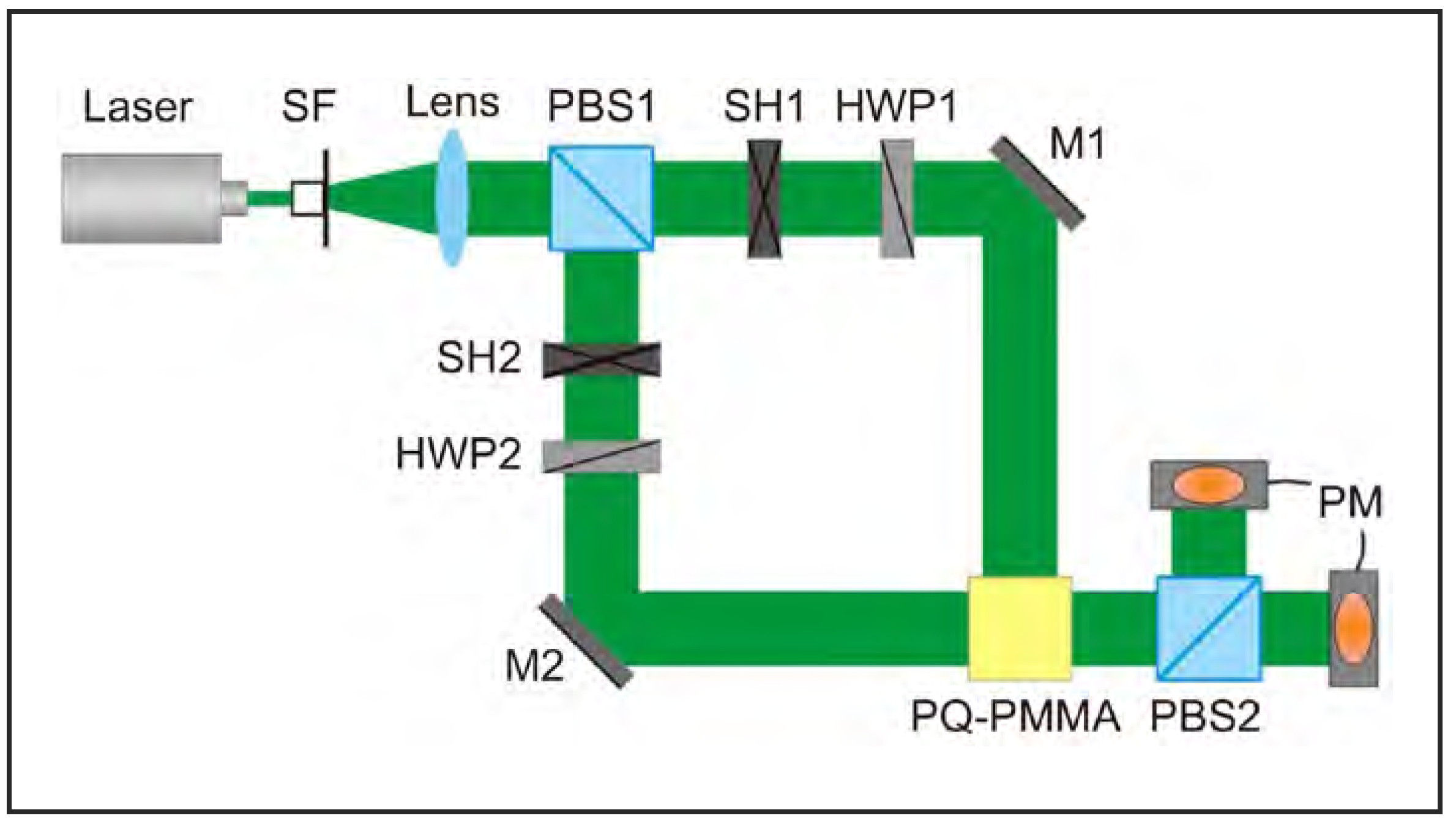 Optical setup of linear polarized holography. SF, spatial filter; PBS, polarization beam splitter; SH, shutters; HWP, half-wave plates (©The Optical Society).
The article explores whether the polarization characteristics of the reconstructed wave is affected by the exposure energy, and then divides it into two categories for discussion.
In the reconstruction characteristics that are independent of the exposure energy, the polarization characteristics of the reconstructed wave change linearly with the exposure energy, which is realized by constraining the polarization state in the process of holographic recording and reconstruction. Combining these reconstruction characteristics, applications such as multi-channel polarization multiplexing, or vector beams generation can be realised.
The experimental results cited in the paper verify that polarization holography can improve information storage capacity or generate vector beams with polarization and phase vortices.
Generally, the polarization characteristics of the reconstructed wave is affected by the exposure energy and present a nonlinear change. These characteristics can provide references for analysing the polarization and diffraction efficiency characteristics of holographic gratings with micro-nano structures.
In addition, it is expected that further research could yield metamaterials with anisotropic refractive index distribution and realise the modulation of the amplitude, phase, polarization and propagation direction of light. This could allow potential applications such as optical metasurfaces, photonic crystals, an all- optical logic gate and polarization sensors.
In conclusion, the paper makes the case that the polarization modulation realised using these polarization characteristics exhibit unusual functionalities, rendering polarization holography as an attractive research topic in many fields of applications.
Subscriber content
Read the full article
Full access to Holography & Optical Technology News articles, newsletters and archives.