
Research Brings Quantum Holography Closer to Reality

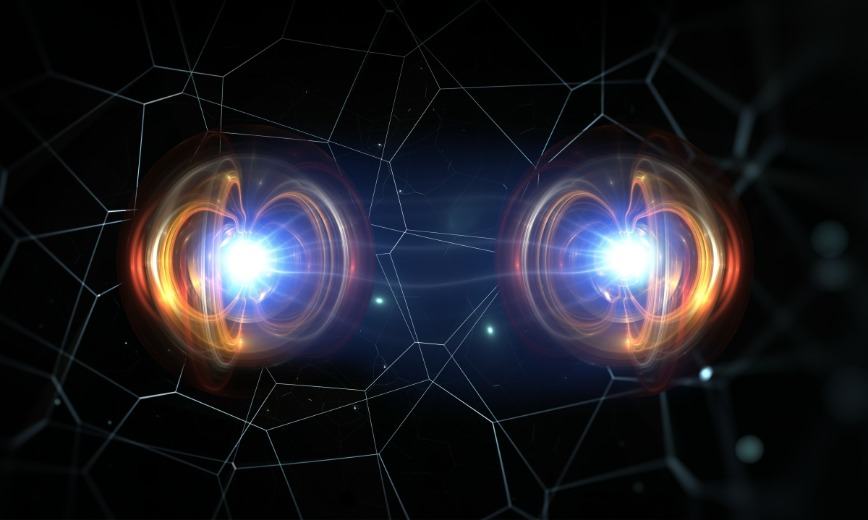
Quantum effects, at a macroscopic level, are generally drowned out by mechanical and thermal vibrations that immerse our everyday experience. In the past few decades, scientists and engineers have been paying more attention to harnessing the quantum properties of matter at a subatomic level to help develop technologies such as quantum communications, quantum computing and quantum imaging.
One example of quantum imaging under examination by Markus Gräfe and colleagues from the Fraunhofer Institute for Applied Optics and Precision Engineering IOF in Jena, Germany, is a new type of holography technique from single photons that record the hologram without detecting the photons themselves.
In classical optical holography, the hologram is the result of the interference of two input beams with mutual coherence. One beam serves as the reference beam. The other beam (object beam) illuminates an object and generates reflected/ transmitted light that bears information of the spatial structure of the object. The profile (width of and spacing between lines) of the interference pattern, resulting from combining the object and reference beams, is recorded in the hologram.
Before moving on to describing quantum holography, we have to consider the role of spontaneous parametric down-conversion (SPDC) as an important process in quantum optics, generating entangled photon pairs and single photons.
SPDC is a nonlinear instant optical process that converts one photon of higher energy (namely, a pump photon), into a pair of photons (namely, a signal photon and an idler photon).
In practical terms, SPDC is accomplished by directing an intense laser beam at a birefringent non-linear optical medium. The pair of photons produced by the process of SPDC has energy and momentum levels that are equal to the energy of the original photon and match the phase of the original photon
In the recently published paper ‘Quantum holography with undetected light’ 1 the research team at the Fraunhofer Institute makes use of two-photon states that can be generated by SPDC in one of two sources. The spatial shape of the object, which is transferred to the spatial shape of the light reflected/transmitted from the object, is contained in the probability amplitudes corresponding to the paired photons being generated in either of two SPDC sources.
Classical holography techniques have been very successful in areas ranging from microscopy, anti-counterfeiting and fundamental research. However, imaging objects with light outside the visible range of the electromagnetic spectrum remains a challenge.
Gräfe explained that with quantum holography they can now spectrally separate illumination and detection of an object. ‘The technique could be useful for bioimaging, which is usually done with mid-infrared light. Since this light is hard to detect, we would illuminate with midinfrared but detect visible light, which is much easier to visualise.’
Photon pair states
To accomplish this, the researchers replaced the classical light beams of standard, phase-shift-based holography with a pair of beams in which the photons are spatially correlated. These two-photon states, known as photon pair states, are generated by SPDC. By exploiting a quantum effect termed ‘induced coherence without induced emission’, it becomes possible to use one of these correlated light beams to illuminate the object, while the other correlated light beam detects the light from the object on a camera.
In a further step, Gräfe and colleagues combined this ‘quantum imaging with undetected light’, as they have dubbed it, with classical holography, so that the technique can be used in realworld applications.
‘Our work is an important step towards quantum imaging and allows to detect objects with light wavelengths that are hard, or indeed impossible, to detect technically,’ Gräfe said in an interview with Physics World.
The researchers say they will now be improving the optical performance of their system. ‘We also want to make it compatible with commercial (laser scanning) microscopes,’ Gräfe added.
Subscriber content
Read the full article
Full access to Holography & Optical Technology News articles, newsletters and archives.