Developing Liquid Crystals for Colour Shifting Anti-Counterfeiting
Idvac Ltd is a private company, based in Manchester Science Park, England, that was founded in 2004 to develop new processes and products for holographic, packaging and solar window films. The company, which has over 25 years’ experience in the holographic and vacuum coating technology markets, is now developing the use of liquid crystals for packaging and security applications.
Liquid crystals are a class of materials that can flow like a liquid but have some degree of order in the arrangement of their molecules – giving them some of the characteristics of a solid. They can be aligned by an applied electric field (amongst other methods) which changes their optical properties.
Over the past few years, there has been an increase in the development of products containing colour shift features for use as a counterfeiting deterrent for brand protection, smart packaging and secure document protection.
Colour shift effects are produced by different mechanisms including pigments, light absorption and interference as well as by photonic crystals – which are optical nanostructures in which the refractive index changes periodically. In industrial applications, various methods have been employed to reproduce these types of effect that rely on physical, chemical, and mechanical principles. They include optical absorption, interference, micro-structuring and light scattering.
Several processes currently exist to achieve controlled colour shift phenomena. Optical coatings, consisting of one or more layers of dielectric or metallic materials, are widely used in applications ranging from mirrors to eyeglasses and interference filters.
Many conventional dielectric coatings rely on Fabry–Perot type interference, where an optical cavity resonator made from two parallel reflecting surfaces emits light of the cavity’s resonant frequency. In fabrication, this involves multiple optical stacks of transparent layers with thicknesses of the order of a wavelength of light to achieve functionalities such as anti-reflection, high-reflection and interference.
Opaque, inorganic Fabry-Perot structures have been used for many years and have excellent colour shifting effects. Typically, structures of this type are made by a vacuum deposition on to a substrate, a reflector layer and a dielectric layer followed by an absorbing layer.
Iridescent flakes used in paints and inks can be obtained from symmetric FabryPerot structures. In this multi-layered stack, two single Fabry-Perot structures share the same reflector. By stripping off the deposited layers in the form of flakes from the substrate they can be printed on to the required film. These flakes can be made opaque or transparent and can be used to make colour shifting paints and inks.
Another process used to produce a colour shift effect is called ‘refractive-type multilayers’. This consists of a limited number of deposited layers (from 3 to 9) with large differences in refractive indexes to produce a stack of high reflection.
An example of this is optically variable ink (OVI). When the average refractive index of the coated stack is sufficiently low, the refractive–type interference structure combines a considerable reflection with a strong iridescent colour shift. This can be done by either having the all-dielectric stack, which consists of high and low refractive index, or the metal-dielectric stack which is opaque. The metal-dielectric stack combines dielectric and metal layers (eg. Al or Cr). This combination can be used to produce OVIs with high reflectance colour shift effect. This type of ink is currently used on some banknotes.
However, all the above processes require vacuum depositing equipment and involve a lengthy process to get the final result.
On the other hand, liquid crystals (LCs) are materials that have the properties of both crystals and liquids. These materials show order and mobility at molecular, supramolecular and macroscopic levels and are seen in everyday life in the form of LC display devices, thermal sensors and so on.
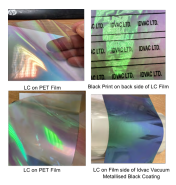
In our recent work at Idvac we have developed a colour shift effect on a flexible film using LCs and without the use of structural embossing, inks or pigments. The product exhibits an aesthetically appealing colour shift effect from red to green depending on the angle of viewing. The LCs can be applied using different coating techniques including printing. After application on a flexible film, the LC coating is dried and UV cured to fix it as a solid at room temperature. The colour shift film produced is transparent and can be recognised in transmitted and reflected visible light.
 © Idvac.
The Idvac new development has the following features:
Single layer application of LC on PET film using standard wet coating application methods such as printing.
The LC colour shift film can be transparent or semi-transparent.
Fast colour change from red to green.
The LC colour shift film is bright and has saturated colours.
The LC colour shift effect is easy to observe from a distance and from multiple viewing angles under standard lighting conditions.
The effect can be combined with other security features, such as a holographic security pattern and a tamper evident layer to make unique products.
The LC colour shift effect can be applied on high refractive index (HRI) coated films for extra reflectance and colours.
The LC colour shift film can be laminated on Idvac vacuum metallised black coated films to achieve a green/deep blue colour shift.
The LC colour shifting film exhibits some polarizing effect when rotated from one angle to another under polarised light.
The production of the LC colour shift film does not require vacuum metallising equipment.
For more details about the development, please contact Prof Nadir Ahmed, [email protected].
Subscriber content
Read the full article
Full access to Holography & Optical Technology News articles, newsletters and archives.