New Optical Banknote Features Come to the Fore After Two Year Hiatus – Part 1

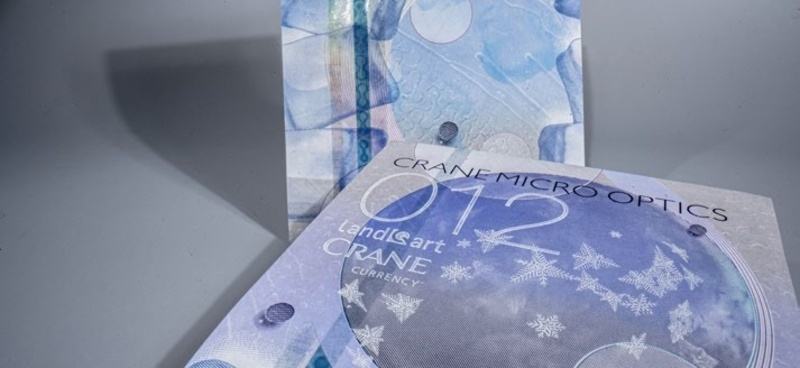
The return of in-person conferences after a break of two years has seen a slew of new optical features launched for banknote authentication.
The Banknote and Currency Conference in Washington DC in February, High Security Printing™ Latin America in Mexico in March, Intergraf in Lyon in April and the Global Currency Forum in Tarragona in May were all opportunities for companies to showcase their latest developments for the first time.
In this article, we cover some of those developments. Part 2 next month will cover those we didn’t have room for this time round.
Long, Longer, Longest Yet
In 2019, the Central Bank of The Bahamas issued the $50 banknote in its new CRISP Evolution series, which used Durasafe® composite substrate from Landqart and included a RAPID® windowed thread from Crane Currency. Not only was this the first note in the world to integrate the micro- optics feature into the composite substrate, but the window itself (at 33mm) is the longest to appear in a circulating note.
It was this success that inspired Crane and Landqart to partner to create a house note – the Hydronote – that combines the Durasafe® ESSENCE substrate with a 3mm wide RAPID HD security thread that is integrated into the length of the note in an 80mm long window. This is the first time a thread has appeared in this size and orientation.
Igniting Possibilities
De La Rue announced a new option for its polymer substrate – SAFEGUARD® ASSURE™. The covert security feature is fully embedded into the core of the SAFEGUARD® polymer substrate and can be detected even if the visible security features have degraded. This solution includes sensors that have been designed specifically for central bank use.
According to De La Rue, ASSURE™ means that SAFEGUARD® now offers a complete solution with level 1, 2 and 3 security features as well as the polymer benefits of secure windows and tactile features for recognition by the visually impaired.
Another development from De La Rue is a series of new effects for its IGNITE® thread portfolio.
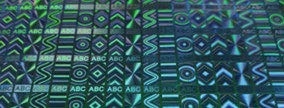 IGNITE® from De La Rue.
IGNITE belongs to the fast-growing combinational thread category, combining precision micro-optic technology with colourshift. The effects already released for IGNITE form part of a geometric range – predominantly based on simple, clean patterns and images that have been designed for high impact. According to De La Rue, advancements to the micro- optic structures means that these effects are even sharper and a new image-based range has now been created which incorporates intricate customisable shapes that move, and alternating sections of text and images, into one thread.
What a Relief!
Oberthur Fiduciaire has launched a technology for threads in the form of RELIEF™ – which offers striking bas-relief 3D effects in what the company terms a major advance in security features for threads and unlike anything else on the market.
The visual effects of RELIEF are equivalent to those of the latest SPARK Flow® Dimension (see AN Jul 2021) – creating the impression of visual tactility, ie. an image or effect that appears to project beyond the surrounding surface, which does not actually exist.
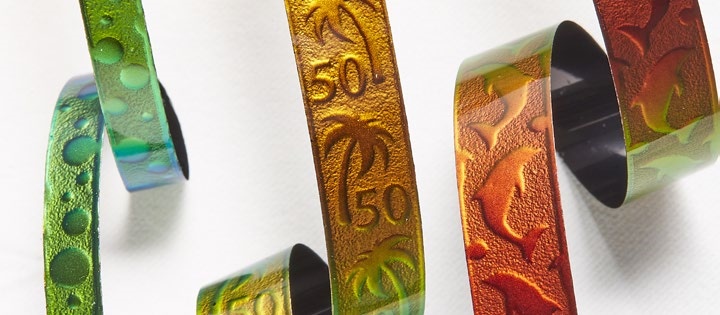 RELIEF™ from Oberthur Fiduciaire.
Unlike SPARK, however, the effect is not created through the alignment of pigments using magnetics, but through the printing process itself, and specifically through liquid crystal inks, the molecules of which have very specific optical properties. It is by manipulating and layering these optical properties that the 3D effects, which are essentially a contrast between light and shadow, are created, along with vibrant colour shift.
Because the process is based on inks alone, smaller features can be created – enabling threads as narrow as 3mm wide to utilise the technology, albeit that the company recommends widths of 4mm and wider for the best effects.
Moreover, no metals are involved. And whilst the appearance has all the hallmarks of embossing, that process isn’t involved either. As such, the technology supports Oberthur Fiduciaire’s Earth 365 philosophy of environmentally-sustainable products and production – metallisation, demetallisation and embossing all having a high impact on the environment. RELIEF products are also thinner than alternatives and can easily be recycled. Finally, they are produced at the company’s facility in Rennes which uses 100% renewable energy.
Five colour variations are currently available (blue-to-purple, green-to-blue, gold-to- green, orange-green and red-to-green), although more colour options are in the pipeline.
RELIEF threads can incorporate machine read features such as magnetics and Cleartext and can be overprinted and/or varnished without any degradation of the image or colour quality.
In addition to threads, the company has also developed (albeit not yet launched), RELIEF stripes and patches that can be applied with or without a transparent window to optimise the display area.
Subscriber content
Read the full article
Full access to Holography & Optical Technology News articles, newsletters and archives.