
Alice (and Maria) Through the Looking Glass

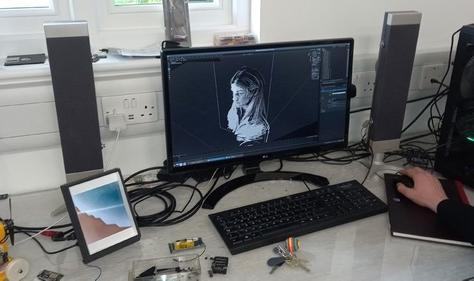
In the March edition of Holography News®, I reported that Dr Ioana Pioaru had started work on holographic sculptures of my daughters, Alice and Maria. From the outset, I realised that the techniques that Ioana uses to create her art are different from other stereogram or light field approaches that I was more familiar with, but I have since learnt the extent of the innovation and collaboration that go into making her holograms.
Lewis Carroll’s book ‘Alice Through the Looking Glass’ – sequel to the novel ‘Alice in Wonderland’ – is perhaps as famous for the book’s illustrations (by John Tenniel) as it is for its prose. In the story, Alice is transported into the virtual world that exists on the other side of a mirror hanging in her house and sets out on a series of fantastic adventures where nothing turns out to be quite as it first appears.
These two themes – the power of images to illustrate a person’s story and the illusive nature of reality – were to come up time and time again in the holographic sculpture process.
The process started with me taking a series of photos of Alice and Maria under instructions from Ioana. At this stage I wasn’t sure what part the photos would play in the process. I imagined that they might be a part of an input sequence of images to a computer-generated stereogram, so I tried to simulate a series of rotational perspectives by setting up the ‘film-shoot’ on a bar stool in my kitchen.
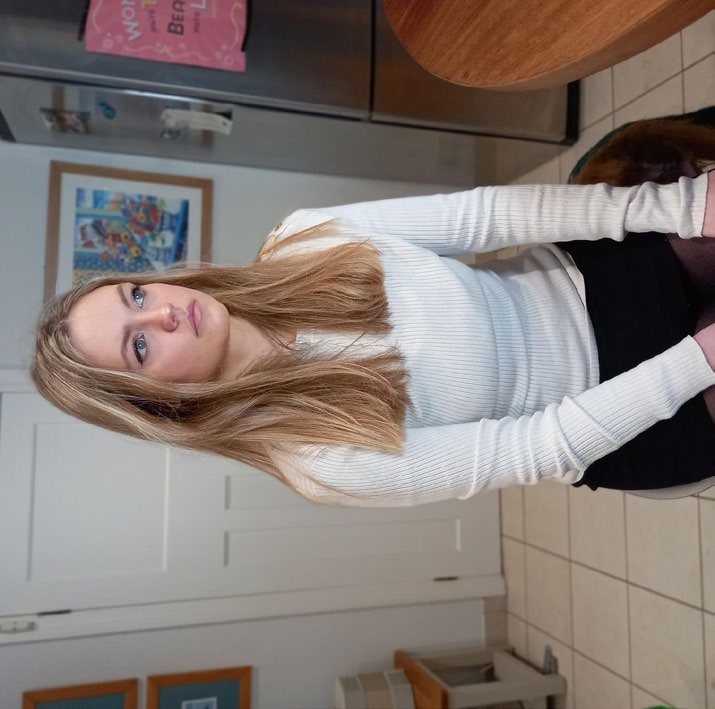 One, from the series of photos of Maria.
Subsequently, I learnt that I needn’t have bothered taking the photos in the round. The purpose of the photos was really just to give Ioana an impression of what Alice and Maria looked like from different angles. After viewing them, Ioana discussed with my daughters which gestures and facial attitudes they most wanted to be captured in the hologram.
From those conversations and images, Ioana started to conjure her magic.
She sketched a series of illustrations, using paper and pencil, that caught the poses and features that Alice and Maria had discussed with her.
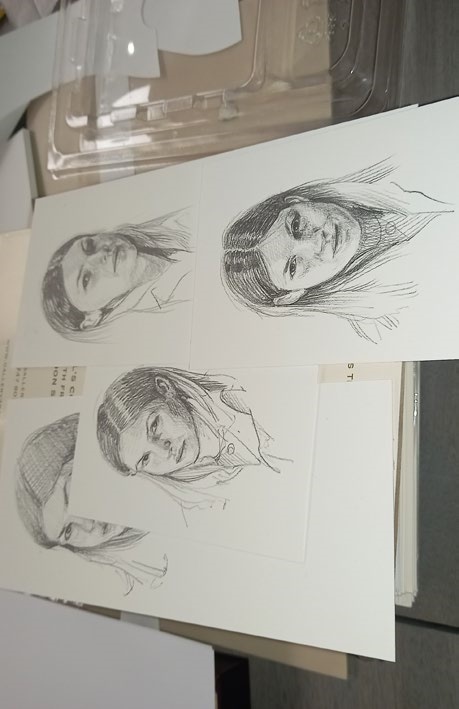 Pencil drawn illustrations of Alice.
Once Ioana felt confident that she had bottled the essence of what my daughters wanted to see in the holograms, she digitised the photos I had sent her and the illustrations she had sketched, and hung them around a virtual room that she had created within an HTC Vive headset.
Wearing the virtual reality (VR) headset and using the handheld controller as her virtual sculpting tool she then drew the hashes, lines and grooves that etched my daughters in a 3D volume, using the illustrations and photos as her guide.
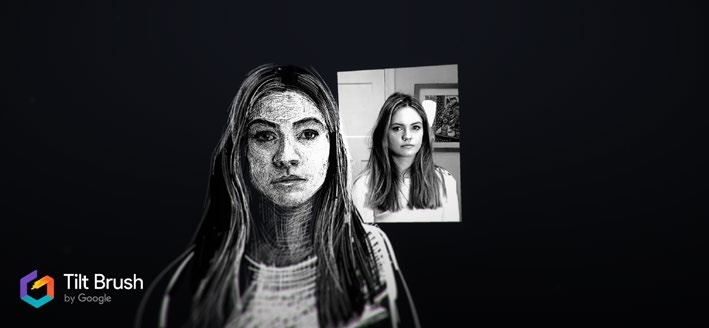 Rough sketch of Maria in Tilt Brush with photo as guide.
Then came the painstaking task of fleshing out the portraits in Tilt Brush with the fine line details that bring a character to life, added to which Ioana had to create images from multiple angles to construct the perspectives that would be fused to form a 3D volume of data in the hologram.
One curious phenomenon that Ioana noticed was that the fisheye lens of the inbuilt Tilt Brush camera introduces significant distortion to the images, which don’t do justice to the VR portrait. The result is that the individual images appear deformed from all angles and from all camera positions – in fact, the closer the camera position to the VR subject (Maria in this case) the worse it is.
In retrospect, this is to be expected as the camera position can only form a single perspective onto the lens’ focal plane – making individual images appear flat and distorted. In a video assembled from the images, the distortion is not so obvious due to the continuous movement of the camera that provides a moving set of views (monocular motion parallax). This in turn provides the viewer’s visual processing with the information it needs to reconstruct the surfaces (as opposed to planes) of Maria’s face and at the same time compensate for the distortions.
After the volume of points, lines and grooves had been created in Tilt Brush, the 3D dataset was exported into a graphics toolset called ‘Blender’ where it was manipulated to allow images that only contained black and white lines. This was a non-trivial task as the software wanted to introduce a grey scale, as it is programmed to give the most appealing images for viewing.
After the image data was manipulated to provide the best black and white images possible – which would be important later in the process to achieve true achromaticity – the images were rendered and image-planed in preparation for their input to Geola’s direct write digital holography (DWDH) system stationed in its Vilnius facility.
A lot of data processing is required to manipulate the output from Tilt-Brush into a form compatible with Geola’s DWDH printers. This is where Ioana has collaborated closely with part-time PhD student (De Montfort, UK) – Tal Stokes. The first holograms Ioana made with this technique were standard 0.8mm hogel (the small volume pixels that make up a light-field hologram) silver halide reflection holograms.
Each hogel contains information from 600-1200 standard pixels along with the corresponding coordinates that are taken from different views of the original 3D scene. Depending on the type of holographic printer deployed by Geola, each hogel is exposed either three times with red, green and blue laser radiation, or simultaneously with all three coloured lasers.
And this is where we must leave the holographic sculptures of Alice and Maria for the moment – with their digitised selves waiting to be reconstructed into wavefronts of manipulated light. So far, I’ve learnt just enough to keep abreast of the technology in play, but as regards the art that Ioana brings to her creations, well that’s still a mystery to me.
To be continued…
Subscriber content
Read the full article
Full access to Holography & Optical Technology News articles, newsletters and archives.