New Technique Reveals How Butterfly Wings Grow into Natural Diffraction Gratings

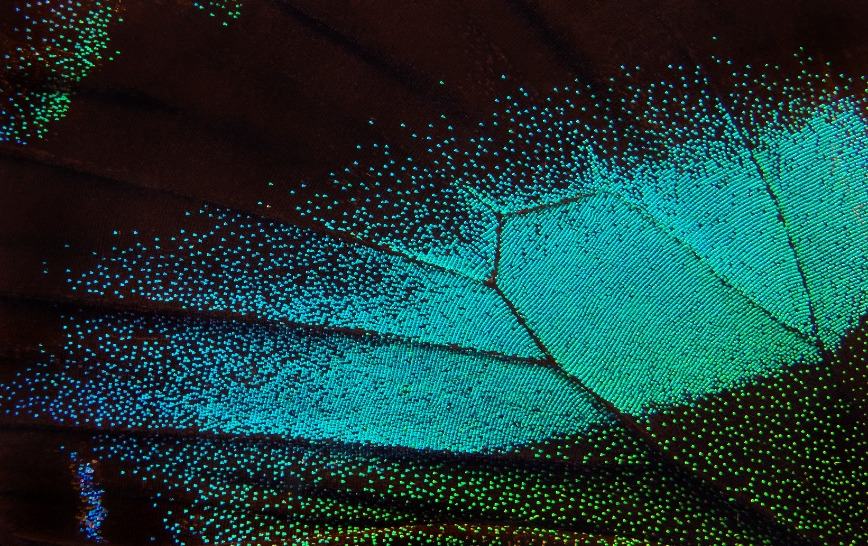
Iridescence and holography are two techniques used in security printing to display colour shifting phenomena that depend on the angle of viewing or illumination of a surface. Colour shifting phenomena also occur naturally in nature, such as the iridescent shimmer of a butterfly’s wings due to the precise structure and arrangement of the microscopic scales on its wings (see HN August 2021).
The iridescence on butterfly wings does not occur from pigment molecules but by how the butterfly wing is structured into what physicists call photonic crystals. A butterfly wing's shimmering qualities materialise when a molecule called ‘chitin’ forms scales arranged like roof tiles. The arrangement acts like a diffraction grating, splitting light into several beams in different directions – dependent on their colour.
Up until now, most of what is known about their formation is based on still images of developing and mature butterfly wings. To get a better understanding of what is happening during the development of the wings, scientists at Massachusetts Institute of Technology (MIT) have developed a way to look inside a butterfly's chrysalis and record in real-time how the wings’ scales develop photonic crystals. The MIT scientists have engineered a way to watch and record the microscopic scales as they grow and tile themselves on a developing butterfly inside its chrysalis.
The team raised painted lady butterflies, Vanessa cardui, waiting for the caterpillars to encase themselves in chrysalises. Once metamorphosis began, the team sliced into the cuticles of each chrysalis and covered the openings with glass coverslips, allowing them to view developing wings through that window. The team recorded wing scale development from start to finish and published their findings in a paper titled ‘In vivo visualization of butterfly scale cell morphogenesis in Vanessa cardui’, published in Proceedings of the National Academy of Sciences of the United States of America 1.
Viewing the wings using a standard beam of light would have damaged the cells. To record the wing's formation process without damaging the delicate cells, the research team used speckle-correlation reflection phase microscopy.
In the team's video footage 2, they found that cells started lining up in rows along the wings' structure within days that metamorphosis began. After initially lining up, the cells began to differentiate themselves in an alternating pattern of cover scales overlaying the wing and ground scales that grew underneath the wing 3. Researchers expected to see the cells wrinkle and compress in the final growth step. Instead, they developed a wavy, ridged structure.
The team plans on further exploring the structure of butterfly wings and the reasoning behind the ridged design. Unlocking the methods behind butterfly scale formation could lead to bio-inspired technology like new solar cells, optical sensors or rain- and heat-resistant surfaces.
1 - https://www.pnas.org/content/118/49/e2112009118
2 - https://news.mit.edu/2021/butterfly-wing-scales-growth-1122
3 -Subscriber content
Read the full article
Full access to Holography & Optical Technology News articles, newsletters and archives.