
Emerging Holographic Displays and Their Impact on Storage Demand

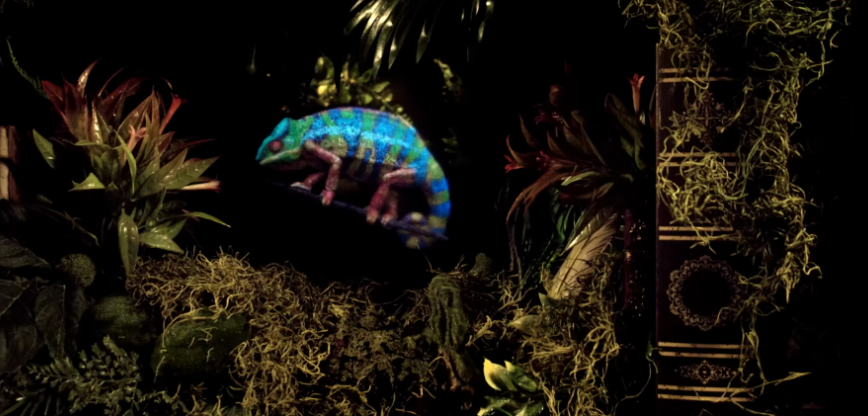
A new paper published in ‘Light: Science & Application’ reviews the recent accomplishments made in the field of holographic 3D displays, while an article in Forbes illustrates how heightened reality images and video will swell the demand for digital storage capacity and bandwidth.
In a new review paper ‘Holography, and the future of 3D display’, published in Light: Science & Application 1, Prof Blanche from the University of Arizona reviews the recent accomplishments made in the field of holographic 3D displays - specifically, the new developments in machine learning and neural network algorithms demonstrating that computer-generated holograms are approaching real-time processing. A section of the paper also discusses the problem of data transmission that can arguably be solved using clever compression algorithms and optical fibre transmission lines.
The paper also reviews what it considers to be the last obstacle to holographic 3D displays, which is the current limitations on the display hardware.
With larger and faster spatial light modulators (SLMs), holographic projection systems are constantly improving. The pixel count on liquid crystal on silicon (LCoS) as well as micro electro-mechanical systems (MEMS) phase displays is increasing constantly, and new photonic integrated circuit phased arrays are making real progress.
It is only a matter of time, the paper argues, for these systems to leave the laboratory and enter the consumer world.
Holography is still looked on as the ultimate technology that will enable rendering of all the optical cues needed for the human visual system to see projected images in 3D. When compared with other heightened reality technologies, such as (auto) stereoscopy, light-field, or volumetric displays, holography is still considered as the ultimate 3D imaging technique. Nonetheless, these technologies will likely prove to be stepping stones leading to better visual comfort until true holographic displays are achieved.
But even these ‘stepping stone’ technologies are, according to a recent article in Forbes 2, beginning to swell the demand for digital storage capacity and bandwidth.
Light Field Lab (see HN November 2021) recently announced its SolidLight high-resolution holographic display platform that enables large-format modular holographic video walls with 10 billion pixels per m2 nominal resolution 3. Each modular panel demonstrated in the announcement modulates the wavefront with over 2.5 billion pixels each, equivalent to over 300 full ultra-high definition (UHD) displays within a 0.5m2 panel, and nearly 5,000 full high definition (FHD) displays per m2. A 90” SolidLight wall provides over 20 billion pixel modulations (8 panels) and a 134” wall (18 panels) provides over 45 billion pixel modulations.
This means that each < 30mm2 region provides the same total resolution as a UHD display (8.3MP) and every 60mm2 already achieves 8K (33MP) density.
This is what Light Field Lab describes as nominal density, whereas they have additionally demonstrated (as seen on their posted holographic chameleon video) 40 billion pixels per m2 effective density, providing for UHD within 15mm2 and 8K every 30mm2.
It is no surprise that the data requirements in trying to capture wavefront simulation are much larger than conventional 2D images, and the storage and bandwidth requirements for such displays will be much greater than for conventional imaging 4. In 2019 David Ward from Cisco said that 12K 360-degree video could require 24.4 TB for an hour of content and require compressed data rates of 54.3 Gb/s 5.
To address the streaming capabilities for holographic media, Light Field Lab has formed a standards body with leading cable and software providers called IDEA 6.
The Immersive Digital Experiences Alliance (IDEA) is a non-profit industry alliance working towards developing a family of royalty-free technical specifications that define interoperable interfaces and exchange formats to support the end-to-end conveyance of immersive volumetric and/or light field media.
One of the projects IDEA is working on is in expanding the Immersive Technology Media Format (ITMF), a suite of royalty-free specifications that establishes a baseline for an interchange of immersive media.
So, it seems that one of the obstacles to bringing high resolution holographic viewing to the market might soon be removed by standardising the format for recording and transmitting heightened reality image data sets.
1 - https://www.light-am.com/article/doi/10.37188/lam.2021.028
2 - https://www.forbes.com/sites/tomcoughlin/2021/12/27/free-floating-immersive-holographic-displays-will-drive-storage-demand/?sh=3a4d4bd17435
3 - Light Field Lab Unveils SolidLight—The Highest Resolution Holographic Display Platform Ever Designs, Light Field Lab Press Release, October 7, 2021.
4 - T. Coughlin “Immersive Storage”, The Art of Storage, IEEE Consumer Electronics Magazine, Nov.-Dec. 2019, pp. 79-80.
5 - T. Coughlin, “Real storage for unreal experiences” [Online] Available on forbes.com
6 - https://www.immersivealliance.org/
Subscriber content
Read the full article
Full access to Holography & Optical Technology News articles, newsletters and archives.