Holograms on the Euro – Series 2

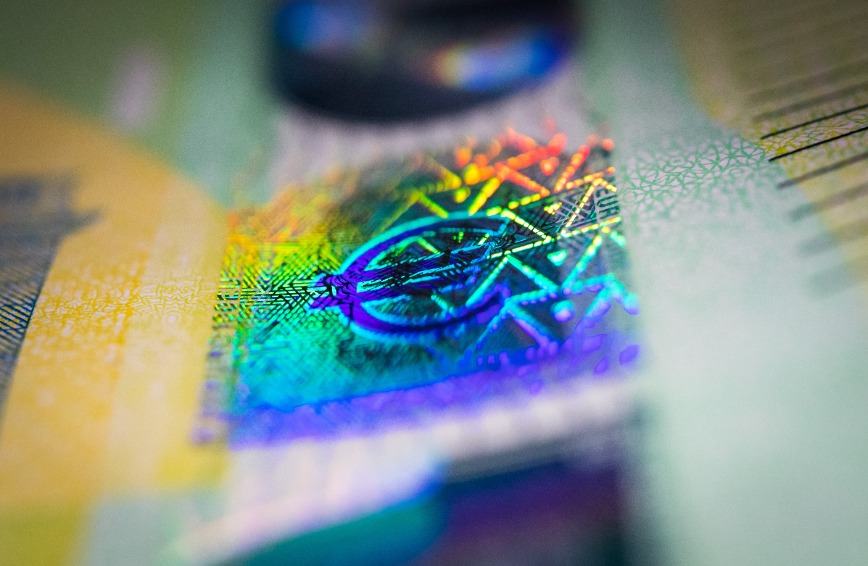
After last month’s commemoration in Holography News® of the 20th anniversary of the launch of the euro (ES1) – and how DOVIDs became the principle overt first level anticounterfeiting device on the new currency – this month I’m going to explore the evolution of diffractive security features as used on the 2nd series (Europa ES2).
At the end of the previous article ‘20th Anniversary of the Launch of the Euro’ (see HN January 2022) I left the story of the success of the use of DOVIDs to the words of the European Central Bank (ECB) report on the evaluation of the 2002 cash changeover 1 – ‘The level (of counterfeiting), when compared with previous experience with the legacy currencies, has indeed been very low’.
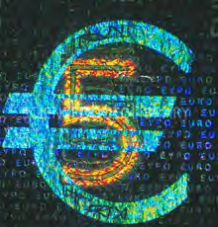
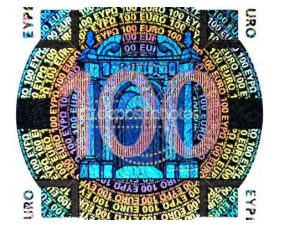
The KINEGRAMS (mastered by OVD Kinegram – now part of KURZ) were applied as stripes on the lower denominations (€5, €10 and €20) and Alphagrams™ (mastered by Hologram.Industries – then SURYS and now a part of IN Groupe) were applied as patches on the four higher denominations (€50, €100, €200 and €500).
The presence and quality of holograms on the euro confirmed that the age of diffractive anti-counterfeiting technology for banknotes had truly arrived, and in excess of 13 billion notes were issued in the first year alone, with every denomination featuring a DOVID.
Between the euro series – opening the window
The now established increased capacity for DOVIDs and their successful application on euro banknotes at high speeds, to tight deadlines and with high standards of quality and security, came as a huge vote of confidence in the technology, paving the way for other central banks to adopt holograms as effective anticounterfeiting solutions for their own new banknote programmes.
Up until this point, DOVIDs were being applied as patches, stripes, or integrated as threads. In 2003, a fourth type of application method was introduced in the new note series issued by the Banque Centrale des États de l’Afrique de l’Ouest (BCEAO) – the central bank for the West African Monetary Union – namely a new diffractive version of Banque de France’s STRAP® technology. STRAP (Système de Transfert Réfléchissant Anti-Photocopie) is a discontinuous wide surface-applied reflective foil that was first applied to the French franc in 1993 and originally featured reflective metallised elements that turned black in colour copiers. The version used on the BCEAO banknotes incorporated holographic elements that changed their image and colour according to the viewing angle.
Another milestone was reached in 2003, when research showed that DOVIDs were now being used on 105 circulating denominations from 47 issuing authorities.
The world’s first paper banknote with an OVD (optically variable device) aperture was introduced by Bulgaria, which issued a commemorative 20 leva banknote in 2004 with an innovative optically complex feature called Varifeye®, developed by Louisenthal (a subsidiary of G+D).
This Varifeye feature involved the creation of a hole in the paper substrate. The hole was not cut out (as subsequent windows in banknotes were) but created during the process of cylinder-mould web paper formation, and a security stripe of film laminated over the aperture, running from top to bottom of the note. The part of the film over the aperture contained a colour shift pattern using liquid crystal technology that provided different effects according to whether the note was viewed in reflected or transmitted light – switching from diagonal stripes to numerals. The stripe also included a diffractive feature, although not over the aperture.
In 2006, KURZ marked the 21st anniversary of the KINEGRAM with the introduction of the KINEGRAM ZERO.ZERO®, based on a new demetallisation process. The name was chosen to capture the key zero tolerance characteristic of the new process, meaning that the demetallisation is perfectly registered to the diffractive KINEGRAM image – a zero tolerance – compared to the typical tolerance of ±0.5 mm of alternative demetallisation processes.
The first application for the KINEGRAM ZERO.ZERO was in the Central Bank of Turkey’s new series introduced in 2008.
That same year, KURZ unveiled KINEGRAM RECOLOR®, a feature designed for transparent windows in banknotes which displays different images depending on the side of the note from which it is observed. On the front the viewer sees a usual metallised reflective, diffractive image, while the reverse view shows a patterned coloured foil also displaying the diffractive features. The feature uses selective demetallisation to highlight different parts of the images.
On the application side, KBA-NotaSys introduced Opti-Windows® in 2007, a module for its Opti-Nota H foil application system that enables printers to cut a window in a banknote and then apply a demetallised holographic stripe directly over this window in one pass and in perfect register at speeds of up to 10,000 sheets per hour.
Europa to the present
It is accepted best practice among banknote issuers to refresh or redesign banknotes every 7-10 years to keep ahead of counterfeits. After ten years, euro banknotes underwent a refresh, with the addition of new imagery which focused on the mythical goddess Europa, after whom the series was named.
Around 2009, it became generally known that the Europa series would retain DOVIDs but in an enhanced, more integrated form that was not possible for the first series due to the large number of suppliers and some printing works having machinery limitations.
After several delays, the new series began rolling out with the new €5 in 2013, featuring a diffractive stripe, as before, but this time in register.
The €10 followed, and then – in another breakthrough for the industry – the new €20 was issued in 2015 containing what the European Central Bank termed a ‘portrait window’. This is a see-through diffractive feature that has different visible effects when viewed from the front, reverse and in transmission, as does the more recent €50. Both notes use a KINEGRAM REVIEW® stripe developed by KURZ.
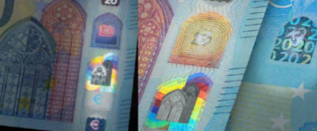 KINEGRAM REVIEW on euro-20 Europa series (© KURZ and ECB).
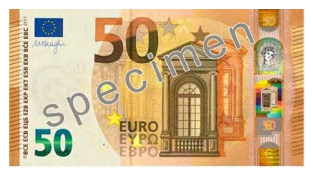 50-euro series 2 (© ECB).
According to Ton Roos, recently retired Director, Banknotes at the ECB, in an interview last month in Currency News™, the holographic window was the biggest challenge in the new series, and the reason for its delay (the new notes were originally intended to start going into circulation in 2010).
‘When I came to the ECB (in 2008), we were facing the challenge of the new REVIEW portrait window feature for the second euro series that now appears in the €20, 50, 100 and 200 banknotes,’ he said. ‘It was the first time this was being used in paper banknotes of any volume, and whilst everyone loved the feature, it was a real challenge to produce it on a large scale and consistently for the billions of notes that a produced every year’.
‘It took us some years to develop the right production equipment, and we had to have really good cooperation with the printing works Europe-wide in order to get this done. So that was a big challenge, and resulted in delays to the introduction of the second series. Of course, it is history now, but it was a real headache at the time’.
Europeans had to wait until May 2019 for the ECB to issue the new €100 and €200 banknotes of the ES2 series. The new public security features on these notes were unveiled on the ECB’s website – introducing a new feature – the so-called Satellite Hologram 2.
At the top of the silvery stripe on the notes, a hologram shows small € symbols that move around the number and become clearer under direct light. The silvery stripe also shows the portrait of Europa, an architectural motif and a large € symbol.
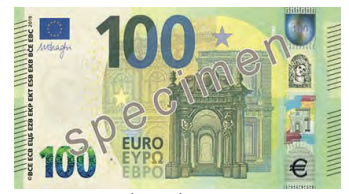 100-euro series 2 (© ECB).
The Satellite Hologram is based on SECTAGO’s proprietary AgilLite® Technology and was developed in close collaboration with the ECB for application on the euro banknotes. When illuminated with a point light source (for example sunshine, spotlight or mobile phone) the true optical characteristic of this feature is unveiled: bright-white appearance and an eye-catching 3D perspective. In addition, upon tilting of the banknote a continuous motion of the AgilLite motif becomes visible.
Euro banknotes are again facing a redesign with a desire to make the currency ‘more relatable to Europeans of all ages and backgrounds’. There’s little doubt that DOVIDs will continue to feature in the new designs in a move from the ECB’s Governing Council to see innovative and secure banknotes that connect with people right across Europe.
Indeed, the latest Study on the Payment Attitudes of Consumers in the Euro Area (SPACE) confirmed that cash was the most popular means for people to pay for retail items in-person in 2019 3. Though the pandemic will have, in all likelihood, affected their popularity as a means of payment.
As we look forward to a new age for the euro, one thing is clear: the role of banknotes in any payments eco-system and the need for secure, cost-effective features that the public recognise remains as strong as ever. The difficulty holograms present to criminals and counterfeiters cannot be overstated; indeed, a third of all current banknotes in circulation (327 and rising) now feature a DOVID. And that is why they will continue to be used by the ECB and other banknote issuing authorities for years to come.
This article contains excepts from the special report 'Diffractive Features on Banknotes' 4.
Subscriber content
Read the full article
Full access to Holography & Optical Technology News articles, newsletters and archives.