Need for Massive Space Telescope Inspires Lightweight Flexible Holographic Lens

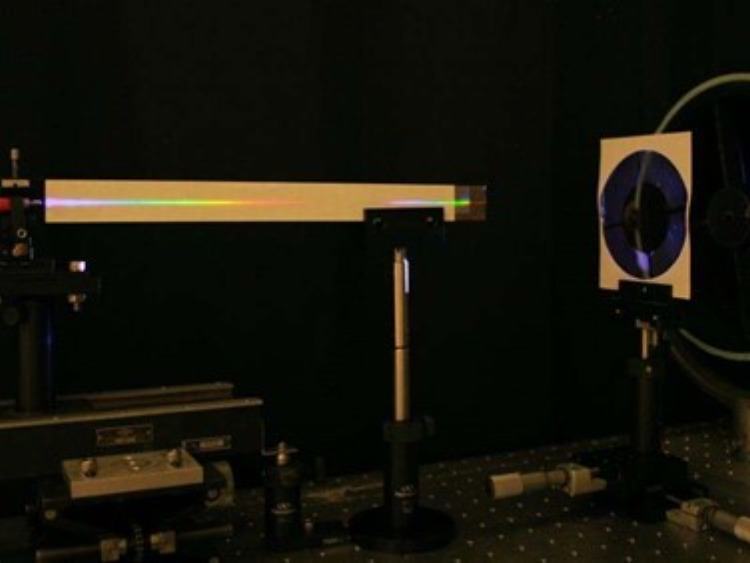
Inspired by a concept for discovering exoplanets with a massive space telescope, a team of researchers is developing holographic lenses that render visible and infrared starlight into either a focused image or a spectrum. An exoplanet is a planet that orbits a star outside our solar system.
The experimental method, detailed in an article appearing in Nature Scientific Reports 1 , could be used to create a lightweight flexible lens, many metres in diameter, that could be rolled for launch and unfurled in space.
‘We use two spherical waves of light to produce the hologram, which gives us fine control over the diffractive grating recorded on the film, and the effect it has on light - either separating light with super sensitivity, or focusing light with high resolution,’ said Mei-Li Hsieh, a visiting researcher at Rensselaer Polytechnic Institute and an expert in optics and photonics who established a mathematical solution to govern the output of the hologram. ‘We believe this model could be useful in applications that require extremely high spectral resolution spectroscopy, such as analysis of exoplanets.’
Telescopes that must be launched into space (to benefit from the superior view outside of Earth's atmosphere) are limited by the weight and bulk of glass lenses, which can realistically span only a few meters in diameter. By contrast, the lightweight flexible holographic lens—more properly called an HOE (holographic optical element)—could be dozens of metres across. Such an instrument could be used to directly observe an exoplanet, a leap over current methods that detect exoplanets based on their effect on light coming from the star they orbit, said Newberg, a Rensselaer professor of physics.
‘To find Earth 2.0, we really want to see exoplanets by direct imaging—we need to be able to look at the star and see the planet separate from the star. And for that, we need high resolution and a really big telescope,’ said Newberg, an astrophysicist and expert in galactic structure.
The HOE is a refined version of a Fresnel lens, a category of lenses that use concentric rings of prisms arrayed in a flat plane to mimic the focusing ability of a curved lens without the bulk. The concept of the Fresnel lens—which was developed for use in lighthouses —dates back to the 19th century, with modern-day Fresnel lenses of glass or plastic found in automobile lamps, micro-optics, and camera screens.
The main function of the Fresnel hologram is to collect the collimated light source and focus it into the detector. When a broad-band light source passes through an annulus diffractive optic, the incident light with different wavelengths will be focused into different positions along the optical axis. It is called dispersion and can be applied for high resolution spectroscopy applications. In this work, the researchers focused their efforts on designing the annulus Fresnel hologram, realising this hologram and demonstrating its unusually large chromatic behaviour.
But while Fresnel holographic optical elements - created by exposing a light-sensitive plastic film to two sources of light at different distances from the film - are not uncommon, existing methods were limited to lenses that could only focus light, rather than separating it.
The new method allows the designers to either focus light onto a single point or disperse it into its constituent colours, producing a spectrum of pure colours, said Lin, corresponding author and a Rensselaer professor of physics, applied physics, and astronomy. The method uses two sources of light, positioned very close to one another, which create concentric waves of light that - as they travel toward the film - either build or cancel each other out.
This pattern of interference can be tuned based on the formulas Hsieh developed. It is recorded onto the film as a holographic image and, depending on how the image is structured, light passing through the holographic optical element is either focused or stretched.
‘We wanted to stretch the light, so that we could separate it into different wavelengths. Any Fresnel lens will stretch the light a little, but not enough,’ said Lin, an expert in photonic crystals and nano-photonics. ‘With our method, we can have super resolution on one end, or super sensitivity - with each colour separated. When the light is stretched like that, the colour is very good, as pure and as vivid as you can get.’
Subscriber content
Read the full article
Full access to Holography & Optical Technology News articles, newsletters and archives.