
Smartphone Report Released

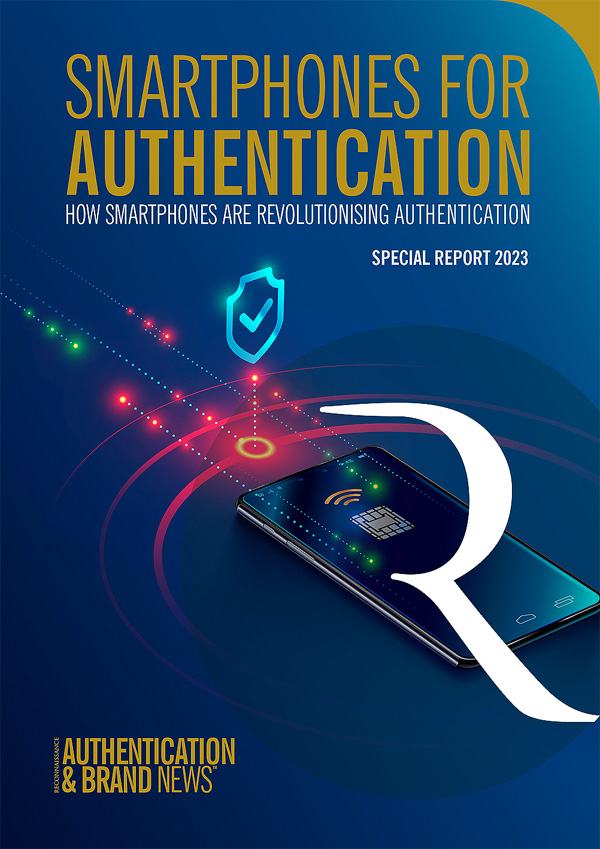
Reconnaissance International is pleased to announce the release of its new one-of-a kind publication – ‘Smartphones for Authentication’
Smartphones are revolutionising the world of authentication, thanks to their ubiquity, connectivity, and computing power. As a result, they have given over 80% of the world’s population (ie. those people currently owning smartphones) the power, not previously available to them, to read barcodes and validate security features, including holograms.
Smartphones are thus accelerating the move towards more standardised holographic authentication methods and are giving rise to technologies that simply didn’t exist before.
These technologies are based on the various embedded attributes of smartphones, including light sources, display screen attributes, biometric capabilities, fingerprint sensors, connectivity, and camera systems.
The current and potential role of these technologies are covered at length in the new report, along with any drawbacks as far as the holographic authentication sector is concerned.
The report also explores the two- way relationship between holograms and smartphones.
Smartphones authenticate holograms
Chapter 3 – Technology for Secure Applications – examines how smartphones now come with a built-in torch to aid photography in dim lighting, which can act as an effective point light source. As such, it is an effective source for hologram authentication and to visualise transparent features on documents.
In this category, the Illumigram™ concept from Toppan is considered in the report (see HN July 2022). This consists of a security hologram incorporating 3D images that appear in response to strong light, such as the flashlight on a smartphone. If the light source is moved, the images also move in accordance with the light.
The approach from nanotechnology engineering company IQ Structures (see HN February 2023) considers the situation where an inspector is checking security features on a document but may not be able to verify it against the database entry for the document. This is where IQ Structures believe their machine-readable holograms can help. The operation of the solution is straightforward: a smartphone with an app illuminates the hologram, the phone reads the feature and then the app confirms its authenticity.
Holograms for smart glasses
Chapter 6 of the report predicts that at some point in the future, another device will replace the smartphone as the main platform of interaction between the ‘real’ and digital worlds.
One strong option for smartphone replacement technology is smart glasses – presenting a specific opportunity for the holography community through the use of holographic optical elements (HOEs) as waveguides.
HOEs are an example of a future application of holography as a route to lightweight, flexible and compact optics. Head-up displays are an example of an application area, initially in military fighter jet cockpits, where wearable technology applications now look set to trigger a resurgence of interest in HOEs.
Head-mounted wearables incorporating displays in the field of view are required to create a comfortable and high-resolution image for the viewer. However, current technologies have a number of optical challenges that are yet to be solved. HOEs could provide a key part of the solution.
The optical challenges refer to the fact that images generated by a display must be somehow transferred into the field of view of the eyes, which is very wide. The brightness and optical attributes such as persistence and flicker must be suitable for the application. And the synchronisation and focus of the two eye displays must be such that it reduces visual fatigue and nausea.
To this must be added some practical needs. The wearable will be head-mounted so must be low weight, low power, and affordable at the price point of the application. It is in these areas that HOEs look set to achieve success.
The ‘Smartphones for Authentication’ report therefore not only describes the wide range of technologies underpinning the role of smartphones in the holographic authentication arena, but also the opportunities for the hologram community in pioneering the next generation of smartphones or their replacements… as well as the potential drawbacks.
Subscribers to any of our newsletters can get this report with an introductory 25% discount.
Subscriber content
Read the full article
Full access to Holography & Optical Technology News articles, newsletters and archives.