
Chris Rich – at the Wavefront of Holography for 35 Years

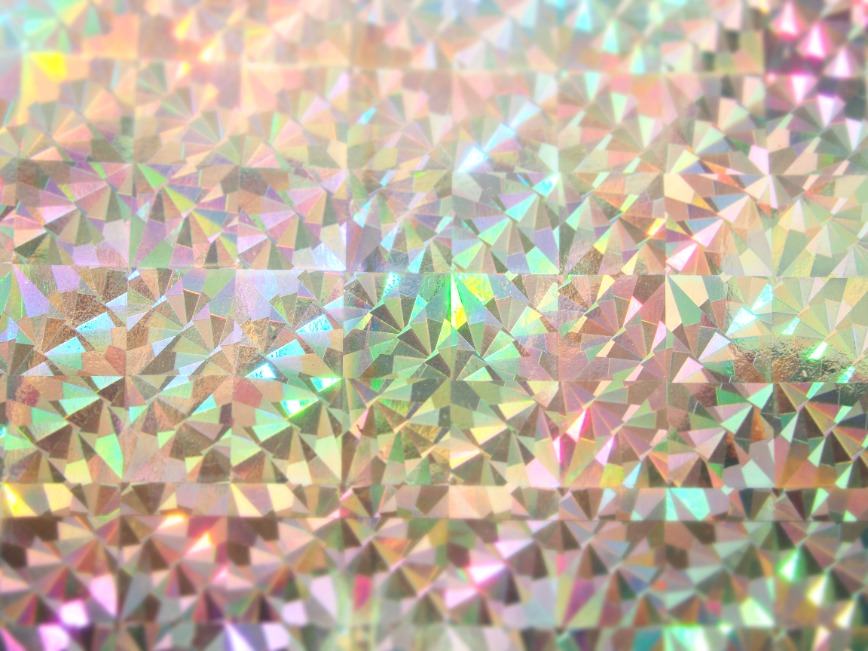
After the initial wave of commercial applications of holography in the early 1980s (see: https://ihma.org/milestones) the holographic industry, at least for transfer films and labels, was spread across four distinct areas of competence: origination, mass-production, converting and application & finishing. As applications for holography became broader, the need for a fifth set of equipment and know-how arose: transferring the master hologram into a format ready for mass-production.
This need, for what might be called pre-production, led to the rise of new companies entering the holography eco-system. One of these companies was WaveFront Technology (www.wftinc.com), founded by Chris Rich and Joel Petersen in Los Angeles in 1986, that offered a service to take in a master hologram (either image or pattern), tessellate the image through a step and repeat process (recombining) and then prepare the shims, ready for replication.
Through the mergers and acquisitions of the 1980s and 1990s WaveFront remained independent and now Chris Rich, who is still CEO of WaveFront, has a new group of optical technologies that he would like to share with Holography News®.
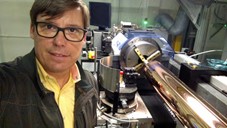 Chris Rich, CEO WaveFront.
Q: Hi Chris, and thanks for reaching out to the HN readership. Let me take you back a few years, and ask how you first got involved in holography?
A: I was on vacation at Walt Disney World’s EPCOT centre in 1983 and saw a large- scale stereogram by Craig Newswanger (Advanced Dimensional Displays) and I knew right there I wanted to have a company involved in making holograms but needed to figure out how to make them.
I came across an article on holography in the Boston Globe that featured Steve Benton and John Caulfield, so I called them up and based on their input moved to Los Angeles to go to school at Pasadena City College in the Laser Electro Optics program run by Dr Waimin Lui.
Q: How did you meet up with Joel and decide to form WaveFront?
A: That was 1983, the first day and first class of college. Joel and I were both trying to add into the early Physics 101 class, which was full, so we met in the hall waiting for the next class to start. This is where we made our first holograms and decided to start a company.
Q: You must have been approached by larger companies during the initial commercialisation era of holography trying to acquire your specialist equipment and know how – were you ever tempted to sell?
A: Absolutely. We have been approached by several large companies to purchase us but never found the perfect match.
Regarding our technology, as we advanced our tooling technology, we became more interested in the production side of the world of embossing. We decided to design and build our own production equipment to match our proprietary tooling technology. These machines are roll-to-roll UV casting systems capable of deep (up to 200 micron), high aspect ratio and high-fidelity microstructures. This was something our customers were not able to do with their standard embossing equipment.
As our experience in making various structures for a variety of markets grew, we became known world-wide as micro-structure specialists.
Q: Are you still in the same facilities that you started in 1986?
A: Yes, we still have our R&D centre in the same building, but we have expanded over the years and now have 60,000 sq ft of production in a newer facility next to the original.
Q: Fast forward several (ok, tens of) years and I read that you and some of the team from WaveFront recently exhibited at The Banknote & Currency Conference in Washington, DC. How did that go for you?
A: The conference was very good for us. The opening keynote speaker (Mark Gould, Chief Payments Executive, Federal Reserve Financial Services) spoke about how he encouraged everyone to step out from their safe zone, meet new people and consider new ideas, new relationships. It really felt like he was talking directly to us and inviting the world to see what we have to offer.
Historically, WaveFront has been a behind the scenes company providing advance services in origination, tooling, and film production. So, this being our first time showing up and the fact that COVID travel restrictions had impacted the attendance for us was a non-issue, and allowed for the necessary time to meet with other attendees that would typically be too busy to talk. We met with many of the security industry experts who all confirmed we have something special and needed in this industry.
Q: You were demonstrating some of your recent technology advances such as Liquid Silver (LS), Liquid Silver Flip (LSF) and Hyperfocal Lens Arrays (HLA) at the conference. Can you say some more about these features?
A: We have always devoted a tremendous amount of time and effort advancing the capabilities at WaveFront from day one.
After the downturn in 2008 we started to develop new ideas to meet the changing world and we saw it.
Liquid Silver (LS) was one of them – it really was based on a simple question from our customers – what is next after the Fresnel Lens Pattern we are known for in the embossing/packaging film market. To us it was obvious; we wanted to maintain the same basic effects as the Fresnel Lens, but we needed to develop a Freeform process that could create images like the evil villain in the hit movie ‘Terminator 2’, with the liquid silver morphing T-1000. Liquid silver Flip (LSF) uses this technology to create distinct images that can be independently viewed at different angles.
HLA is a 1D lens array over a patterned microstructure that provides a high contrast image that can Flip, Shift, and even Animate. We have 3 film thickness offerings at 80, 35, and 20 microns.
Q: What are the technologies on the horizon that you believe will have the biggest impact on holography in the future?
A: Integration of macro, micro and nanostructures into one feature. This is why we have invested so heavily in Diamond Turning Advancement, Freeform lithography and now a large format E-beam writing system. Having the ability to arrange the diverse structures all in one element and potentially aligning them on both side of a film simultaneously with a higher degree of accuracy than currently in the market today.
We feel this is the next wave of holography and we are leading it now.
Q: What do you see the next five years bringing for you and WaveFront?
A: We continue to produce packaging films that combine Fresnel lenses with holographic patterns such a rainbow. Our newest package in the stores today is Alka Seltzer. For sustainability, our transfer films have been tested and passed Western Michigan University SBS Equivalency (WMU SBS-E) testing protocol for recyclability. We have also developed Fresnel lenses for hot stamp and cold foil applications.
We are looking to grow and find a strategic partner that has what we are missing – a proven production capability into the security marketplace.
We have more development in the queue specifically targeting ‘see thru’ effects with optical efficiency rivalling volume holograms, but without the downside of their production cost that have limited their adoption into the market.
While COVID slowed our lighting films entry to market, we now expect significant growth in this business area over the next three years. For that market, we have developed a suite of films that transform a standard flat LED lighting panel into a deep holographic like 3-D effect while efficiently managing its light output.
We produce holographic diffusers, prismatic films and glare control films as well. Our inhouse origination technology includes holography, diamond turning, freeform lithography and soon e-beam lithography that gives us capabilities unlike any company in the world today.
What is next is only limited by our innovation and that has proven to be market transforming.
Subscriber content
Read the full article
Full access to Holography & Optical Technology News articles, newsletters and archives.